



As a Product Manager in an online travel business, you don’t feel hotel inventory problems on day one. They surface quietly as you scale- when adding a new supplier creates duplicate hotels, when search results start looking messy, and when ops teams step in to “fix” things manually. What initially feels like a data inconsistency soon becomes a product bottleneck that slows experimentation, complicates releases, and erodes customer trust. At the center of it all is one underestimated challenge: hotel identity. If you don’t solve it early, every new supplier makes your inventory harder to manage, not easier.
In this blog, we’ll break down what it really takes to build a unified hotel inventory when your data comes from multiple sources. We’ll look at why hotel identity is a product decision, not just a data problem, how hotel mapping enables scalable inventory unification, and the key trade-offs you’ll need to navigate as your platform grows. Let’s begin.
TL;DR
- A fragmented hotel inventory doesn’t fail immediately; it quietly slows your product as you scale.
- Duplicate hotels and inconsistent listings are symptoms of an identity problem, not just bad data.
- A unified hotel inventory means one canonical hotel entity mapped to multiple supplier listings.
- Hotel identity is a product decision; if you don’t define it, every supplier integration will.
- Manual cleanups and rule-based fixes don’t scale once the supplier count grows.
- Unified inventory improves search relevance, onboarding speed, and reduces operational dependency.
- Stable hotel identity unlocks faster market expansion and future roadmap initiatives.
- Treat hotel inventory as a long-term product asset, not backend infrastructure.
The Real Issue Isn’t Data Quality, It’s Hotel Identity
When hotel inventory starts showing cracks, the instinctive response is to blame data quality. Supplier feeds are inconsistent. Fields don’t line up. Some hotels are missing images or amenities. On the surface, this feels like a problem that better validation rules or stricter schemas can fix.
But as a Product Manager, you quickly realize that improving data quality doesn’t eliminate duplicates or inconsistencies; it just standardizes them.
The same hotel still exists as multiple identities across suppliers. One feed lists it under a brand name, another under a local name. Addresses differ slightly. Location coordinates aren’t exact. Each supplier insists their version is correct, and technically, they all are.
Without a single, canonical definition of what a hotel is on your platform, every downstream system makes its own assumptions-
- Search treats them as separate entities.
- Pricing compares them incorrectly.
- UX surfaces inconsistent information.
Over time, teams start building supplier-specific logic just to keep things working.
This is why hotel identity is not a data problem; it’s a product decision. Until you define how a hotel is identified, resolved, and maintained across sources, no amount of data cleanup will give you a truly unified inventory.
What a “Unified Hotel Inventory” Actually Means for You as a PM
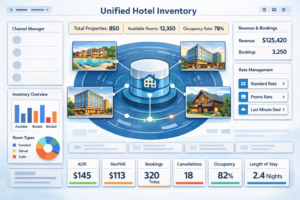
Once you recognize that hotel identity is a product decision, the next question becomes unavoidable: what does “unified inventory” actually look like in practice?
For many teams, it’s misunderstood as a large, cleaned-up database where all supplier fields are normalized. For others, it’s seen as a one-time exercise- merge duplicates, fix obvious issues, and move on. Neither approach holds up once your platform starts scaling again.
As a Product Manager, a unified hotel inventory means having one canonical representation of a hotel that your entire platform can rely on. Search, pricing, content, and analytics all point to the same entity, even though the data may originate from multiple suppliers. Each supplier’s version of a hotel is mapped to this canonical entity rather than treated as a separate listing.
This separation is critical. Hotel identity remains stable, while supplier-specific content, rates, and availability can change independently. When done right, this structure absorbs new suppliers, new markets, and new edge cases without destabilizing the rest of the product.
At that point, unified inventory stops being a cleanup task and starts behaving like what it should have been all along- a long-term product asset.
Steps to Build a Unified Hotel Inventory from Multiple Sources

Once you accept that hotel identity is a product problem, the focus shifts from why it matters to how you design for it. Building a unified hotel inventory isn’t a single task you check off, but a sequence of deliberate product decisions that compound over time.
Here’s how you should approach it as a Product Manager:
Step 1: Define What a “Hotel” Means on Your Platform
Before touching supplier data, you need a clear internal definition of a hotel.
Is a hotel defined by its name and address? Its geo-coordinates? A brand and property code? In reality, it’s a combination, but the key is deciding which attributes are authoritative and which are flexible.
Without this definition, every team ends up making its own assumptions. Search, pricing, content, and ops all operate with slightly different versions of the same hotel, which is how fragmentation begins.
Your first job is to define a canonical hotel entity that your entire platform agrees on.
Step 2: Separate Hotel Identity from Supplier Listings
A common mistake is treating supplier listings as hotels themselves.
Instead, you need a clear separation:
- Hotel identity: the stable, canonical representation
- Supplier listings: variable representations tied to that identity
This separation allows you to map multiple supplier listings to a single hotel without duplicating across your platform. It also gives you the flexibility to change supplier data without breaking the core identity.
As a PM, this is a structural decision that determines how scalable your inventory will be.
Step 3: Use Hotel Mapping to Resolve Identity at Scale
At this stage, hotel mapping becomes essential. Manually matching hotels or relying on basic rule-based logic might work for a small set of suppliers, but it breaks quickly as volume increases. Variations in naming, addresses, languages, and metadata introduce ambiguity that deterministic rules can’t handle reliably.
Hotel mapping resolves this by using a combination of normalization, probabilistic matching, and confidence scoring to determine when multiple listings represent the same hotel. The goal isn’t perfection, it’s high-confidence identity resolution at scale.
Step 4: Design for Continuous Updates, Not One-Time Cleanup
Hotels change. They rebrand, renovate, merge into chains, or update their location details. New suppliers come in with new interpretations of the same property.
If your unified inventory assumes a one-time merge, it will drift out of sync quickly.
You need to design your inventory as a living system, one that continuously ingests updates, re-evaluates matches, and maintains identity over time. This is where automation becomes non-negotiable.
Step 5: Plan for Edge Cases Before They Hit Production
Every PM underestimates edge cases at first. We’re talking about independent hotels with sparse data. Properties with multiple entrances. Hotels operating under multiple brand names. Long-tail inventory with inconsistent metadata.
Ignoring these doesn’t make them go away; it pushes complexity downstream. The more intentional you are about how edge cases are handled, the fewer emergency fixes your team will need later.
Step 6: Measure Success Beyond Match Accuracy
It’s tempting to measure success purely in terms of match percentage or accuracy scores. Those metrics matter, but they’re not the outcome you’re accountable for.
What really tells you if unified inventory is working:
- Fewer duplicate hotels in the search
- Faster supplier onboarding
- Reduced manual intervention
- Improved search relevance and conversion
When those metrics improve, your inventory is doing its job even if it’s invisible to users.
How a Unified Hotel Inventory Improves the Metrics You’re Accountable For
As a Product Manager, the success of a unified hotel inventory isn’t measured by how clean your data looks in the backend. It’s measured by how much friction it removes from the product and how reliably it improves outcomes you’re responsible for.
The most immediate impact shows up in search and discovery. When each hotel exists as a single entity, relevance tuning becomes easier and more predictable. Hotels no longer compete with themselves, rankings stabilize, and users see cleaner results without obvious duplicates.
Unified inventory also reduces supplier onboarding time. Instead of handling duplicates and exceptions manually for every new integration, suppliers map into an existing structure. This shortens go-live timelines and allows your team to add supply without slowing down the roadmap.
There’s also a noticeable reduction in operational dependency. Fewer manual merges, fewer overrides, and fewer “quick fixes” mean your team spends less time maintaining inventory and more time building features that move the product forward.
Most importantly, unified inventory improves user trust, even if users never consciously notice it. Consistent hotel details, stable pricing comparisons, and reliable content create a sense of confidence that directly impacts conversion and repeat usage.
Unified Hotel Inventory as a Platform Growth Enabler
Once your hotel inventory is unified, scale stops being a source of anxiety and starts becoming an advantage.
Adding new suppliers no longer threatens search quality or catalogue stability. Expanding into new geographies becomes less about cleaning data and more about strategic partnerships. The platform becomes resilient to growth instead of fragile because identity resolution is already built into the foundation.
Unified inventory also unlocks future roadmap initiatives. Personalized hotel recommendations, AI-driven discovery, dynamic packaging, and cross-sell features all rely on a consistent understanding of what a hotel is. Without a unified inventory, these features become hard to implement and harder to trust.
From a PM perspective, this is where the payoff becomes clear. Your roadmap moves faster because your foundation is stable. Your team spends less time reacting to inventory issues and more time delivering meaningful product improvements.
Your Hotel Inventory Is a Product Decision, Not Infrastructure
As a Product Manager, you don’t get credit for hotel inventory when it works, but you pay the price when it doesn’t. Duplicate listings, unstable search, slow supplier onboarding, and growing operational dependency are all symptoms of the same underlying issue: hotel identity was never treated as a first-class product decision. Building a unified hotel inventory from multiple sources isn’t about perfection on day one. It’s about setting up the right foundations so your platform can grow without fighting itself. When hotel identity is clearly defined and consistently maintained, everything downstream- search, pricing, discovery, and expansion becomes easier to build and easier to scale.
The earlier you take ownership of this problem, the more leverage you create for every future product decision. Fix hotel identity early, and your inventory stops being a bottleneck and starts becoming a competitive advantage.
FAQs
- What does “unified hotel inventory” mean in an online travel platform?
A unified hotel inventory means maintaining a single, canonical representation of each hotel across your platform, even when listings come from multiple suppliers. All supplier-specific data, like content, rates, availability, and maps, back to this core hotel identity, ensuring consistency across search, pricing, and user experience.
- Why is building a unified hotel inventory a Product Manager’s responsibility?
Because hotel inventory directly impacts core product outcomes like search relevance, conversion, supplier onboarding speed, and roadmap velocity. When hotel identity isn’t defined at the product level, teams rely on manual fixes and supplier-specific logic, slowing down development and scaling.
- Can’t duplicate hotels be fixed with better data cleaning?
Data cleaning helps, but it doesn’t solve the root problem. Duplicate hotels occur because the same property is represented differently across suppliers. Without a defined canonical hotel identity, data cleaning simply standardizes inconsistencies instead of resolving them.
- When should a PM start thinking about unified hotel inventory?
Much earlier than most teams do. Inventory fragmentation usually becomes visible only after scaling, but fixing it later is significantly harder. Defining hotel identity early prevents complexity from compounding as suppliers and markets are added.
- How does unified hotel inventory impact business growth?
Unified inventory reduces friction across the platform. It enables faster supplier onboarding, cleaner search results, improved user trust, and smoother market expansion, making growth easier to manage without increasing operational overhead.