


The Global Distribution System has been the backbone of corporate travel for decades. For most Travel Management Companies, systems like Amadeus, Sabre, and Travelport still sit at the center of hotel sourcing, airline distribution, and corporate rate access. Negotiated rates, policy controls, and global inventory have traditionally flown through these networks. Yet something interesting is happening in corporate travel today. Travelers expect the same clarity and ease they see on consumer platforms such as Booking.com or Expedia. Corporate booking environments, however, still struggle with fragmented hotel content, mismatched room types, and confusing rate displays.
If the GDS still provides access to massive global inventory, why does the booking experience still feel messy for many TMCs? The answer lies in the structure of the content itself. Understanding where the problem begins requires a closer look at how legacy GDS hotel data was originally designed.
The Legacy Content Problem: Where GDS Falls Short Today
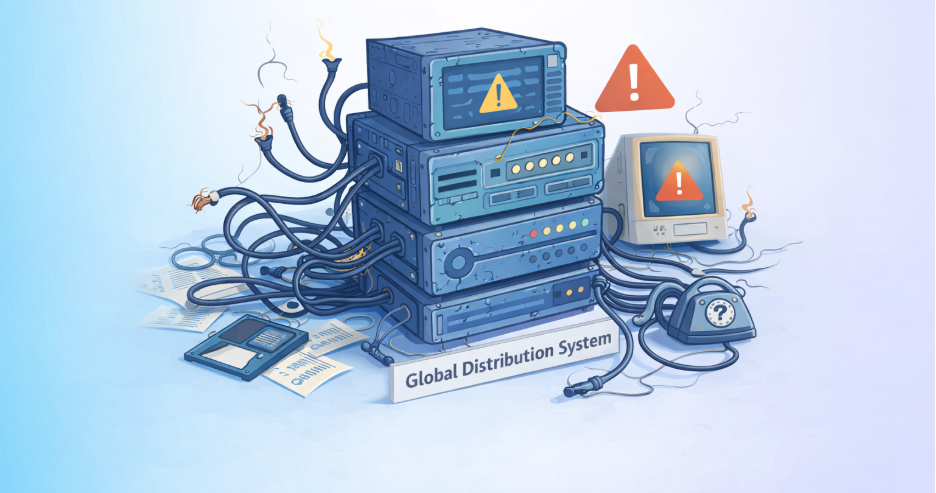
Legacy architecture sits at the heart of the GDS content challenge.
Most GDS hotel feeds were designed long before modern digital travel platforms emerged. Content fields were limited. Standardization across suppliers was minimal. Rich media, detailed attributes, and standardized room taxonomy were never part of the original design.
The result is inconsistent hotel content across the ecosystem.
A single hotel property may appear under slightly different names across multiple feeds. Address formats vary. Property identifiers change depending on the source, and some listings contain detailed amenities while others provide only basic descriptions. Duplicate listings often appear for the same hotel when a TMC aggregates supply from the GDS alongside bedbanks or direct hotel connections.
Room-level inconsistencies create an even bigger issue.
Room descriptions are rarely standardized across suppliers. One feed may label a room as “Deluxe King.” Another source may list the same room as “King Deluxe Room.” A third supplier may include extra descriptors such as “City View King Deluxe.”
All three descriptions might represent the exact same room category.
Booking platforms that lack intelligent room mapping treat them as different products. Agents and travelers then face multiple options that appear unique but are actually identical. Rate plan descriptions add another layer of confusion. Some suppliers describe inclusions clearly while others rely on abbreviations or short codes that require interpretation. The following outcomes then unfold:
- Operational teams feel the impact immediately.
- Agents lose time verifying room details.
- Booking confidence drops when travelers cannot easily compare options.
- Corporate clients question pricing differences when duplicate listings appear for the same hotel. Industry data confirms the scale of the issue.
A research from Phocuswright shows that travel sellers now rely on multiple supply sources to remain competitive. A typical OTA may integrate dozens of suppliers. Many TMC platforms follow a similar approach to improve rate competitiveness.
More supply sources mean more content inconsistency.
A fragmented content layer quietly erodes efficiency across the organization. Reporting becomes less reliable. Supplier negotiations become harder to evaluate. Data analytics lose accuracy when properties cannot be matched across sources.
None of this stems from poor technology within the GDS itself. Legacy architecture simply was not designed for today’s multi-source distribution landscape. Modern TMCs must solve this challenge at the content layer. The next segment explains ‘why’.
Also Read: 10 Best Hotel Data Hygiene Tips for Tour Management Companies (TMCs)
Why This Matters More Than Ever for TMCs
Corporate travel expectations have changed dramatically.
Business travelers now expect booking experiences that mirror consumer travel platforms. Clean property listings, clear room descriptions, and easy comparisons are no longer luxuries. They are baseline expectations. Corporate travel programs also demand more transparency than ever before. Travel managers want visibility into hotel spending patterns, supplier performance, negotiated rate compliance, and traveler preferences. Fragmented hotel content makes those insights harder to generate.
The complexity of the supply ecosystem compounds the challenge.
Many TMCs combine hotel inventory from GDS sources with bedbanks such as Hotelbeds and WebBeds. Direct hotel contracts also play an important role for corporate programs. Aggregators and API-based suppliers continue entering the distribution landscape. Each source delivers content in its own structure. Without intelligent content normalization, booking platforms struggle to present unified hotel options. Duplicate listings appear. Rate comparisons become unreliable. Corporate travelers end up seeing cluttered booking results that reduce confidence in the platform.
Margins also come under pressure when content is not structured properly. A TMC may receive the same hotel inventory from multiple suppliers at different prices. Accurate room mapping and property matching allow the system to identify the best rate instantly. Poor content mapping hides those opportunities.
Industry trends reinforce the need for smarter distribution strategies. A research highlighted by Skift Research suggests that direct digital channels are steadily increasing their share of hotel bookings. Competitive distribution requires travel sellers to optimize every available supply channel.
TMCs that cannot present clean, comparable inventory risk losing relevance in a rapidly evolving ecosystem. Organizations that invest in structured hotel data gain operational efficiency and stronger supply optimization. Clean data also strengthens analytics, which supports smarter supplier negotiations and program management. Modernizing the content layer unlocks value that many TMCs already possess within their supply network.
The challenge lies in organizing it properly. The next section focuses on the steps to fix the structure of hotel content before it reaches the booking interface.
Learn about the complexities of hotel inventory management and explore how advanced mapping solutions can bring clarity and efficiency to the process.
Modernizing the GDS Layer: How to Turn Raw Feeds into Structured Intelligence
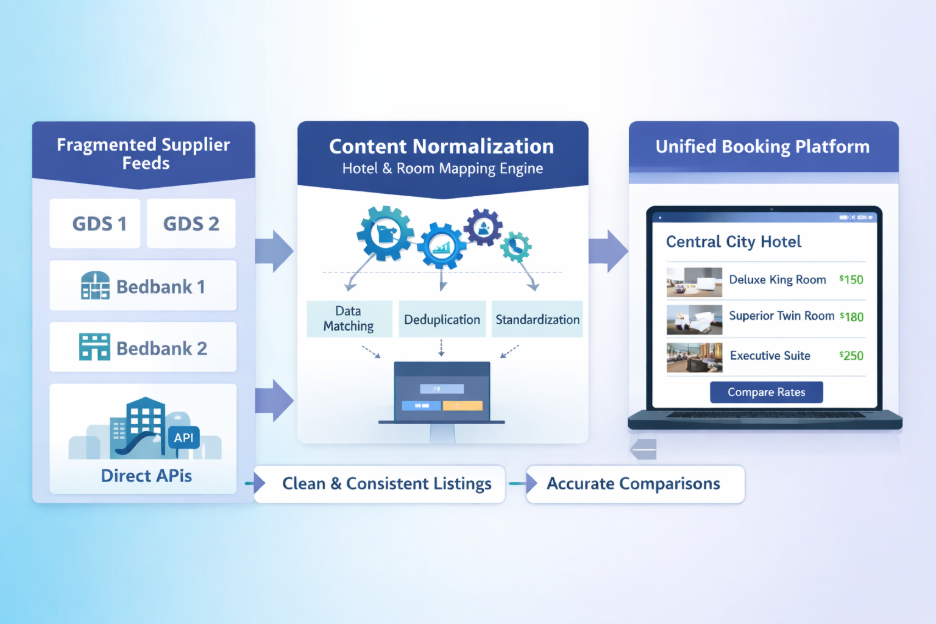
The path forward for TMCs does not involve abandoning the GDS. The real opportunity lies in transforming raw hotel feeds into structured, comparable, and reliable content.
Hotel mapping forms the foundation of this transformation.
Every supplier identifies properties differently. Some rely on internal property codes. Others use partial addresses or inconsistent naming formats. Intelligent hotel mapping technology analyzes thousands of data signals including name variations, geolocation, addresses, and brand affiliations to determine whether two listings represent the same property. This process creates a unified hotel identity across multiple supply sources.
Once properties are matched correctly, the next challenge emerges at the room level.
Room mapping ensures that identical room categories from different suppliers are recognized as the same product. Advanced room mapping engines analyze room names, descriptions, attributes, and amenities to determine equivalency.
Clean room-level mapping enables booking systems to compare rates accurately across suppliers. Agents and travelers then see a single property listing with clearly comparable room options. Rate differences become transparent. Decision making becomes faster.
Operational efficiency improves immediately when the content layer becomes structured.
Many travel technology companies now integrate intelligent content normalization solutions to support this transformation. Vervotech’s hotel mapping and room mapping APIs are designed specifically to address these challenges across multi-source travel environments.
The technology standardizes hotel identities across suppliers and matches room categories using advanced data processing. Travel platforms that integrate such capabilities gain a unified hotel catalog, clean booking displays, and reliable cross-supplier comparisons.
The impact extends beyond booking interfaces.
Structured hotel data improves reporting accuracy and strengthens supplier analytics. Procurement teams can evaluate supplier performance more effectively when hotel data remains consistent across sources. Corporate travel programs benefit as well. Policy compliance becomes easier when properties are mapped accurately. Preferred hotels can be surfaced clearly without confusion caused by duplicate listings.
Also Read: Optimizing Supplier Connectivity: How Clean Hotel Data Increases Booking Efficiency
The Future of GDS in a Multi-Source World
The GDS remains one of the most powerful distribution networks in travel.
Corporate travel programs rely on negotiated rates, global availability, and policy controls that GDS platforms continue to provide at scale. Predictions about the disappearance of the GDS have circulated for years, yet the system continues evolving alongside the broader distribution ecosystem.
What has changed is the role it plays within modern travel infrastructure.
The GDS no longer operates as the only source of hotel inventory. It functions as one of several supply channels feeding travel platforms. Bedbanks, direct connections, and emerging marketplaces have expanded the supply landscape significantly. TMCs that treat the GDS as a standalone system face growing operational friction. Those that integrate it within a structured content architecture unlock its full potential. The future belongs to organizations that manage content intelligently rather than simply collecting it.
Solutions such as Vervotech’s hotel mapping and room mapping APIs help travel platforms convert fragmented supplier feeds into a unified hotel catalog that powers smarter distribution decisions.
Modernizing the content layer turns legacy infrastructure into a competitive advantage.
TMCs that invest in this capability move beyond operational inefficiencies and focus on delivering better travel experiences. The GDS continues to power global distribution, but the organizations that truly win in this environment are the ones that transform raw travel data into structured intelligence. That change has already started reflecting across the industry. The next wave of corporate travel innovation will belong to the companies that embrace it.
If you want to see how structured hotel data can simplify your supply ecosystem, consider taking a free trial of Vervotech’s mapping solutions to explore how intelligent hotel and room mapping works in practice.