


hus, tBetween the moment a customer confirms a booking and the moment they check in, hotel prices move. Sometimes they move a little. Often, they move significantly. In high-demand corridors during the weeks before arrival, the same room that sold for say, $180 at booking may be available from a different supplier at $140.
Your revenue team knows this. What they have not done is build a systematic mechanism to act on it.
Most OTAs treat rebooking as a customer service response: if a customer calls with a complaint about a price drop they found themselves, you rebook them as a goodwill gesture. This is the most expensive way to run rebooking, because the cost is absorbed entirely by your margin, and the trigger is customer dissatisfaction rather than price intelligence.
The commercial case for rebooking looks completely different when it is treated as a proactive margin recovery operation. Here is the P&L argument your revenue team should be making.
The Window Between Booking and Check-In Is an Arbitrage Opportunity
A confirmed hotel booking is a price lock at the moment of transaction. The customer is committed. Your supplier’s obligation is set. But the market price of that room does not stay fixed just because the booking was made.
Supplier rates change continuously in the period between booking confirmation and check-in: yield management systems adjust based on occupancy, flash promotions run for specific date windows, and last-minute availability pricing creates temporary dips that disappear within hours.
The current trends across OTA booking portfolios suggest that about one-fifth of the confirmed bookings will see a lower rate available from at least one supplier within the 30 days prior to check-in. For long lead-time bookings (booked 60+ days out), the rebookable proportion is often higher.
The arithmetic is straightforward. An OTA processing 50,000 room nights per month with an average booking value of $200 and an average rebookable margin of $22 per room night has a rebooking opportunity pool of roughly $275,000 per month. On a conservative capture rate of 40%, that is $110,000 in recovered margin per month that currently does not exist in the P&L.
That number is not a projection. It is an accounting of what is already there.
Why Revenue Teams Have Not Acted on This
The gap between the economic opportunity and the operational reality exists for a specific set of reasons. Understanding them is the first step to dismantling them.

- The mental model is wrong. Revenue management in OTAs is primarily built around demand forecasting, rate shopping, and channel optimization at the time of booking. The period after booking confirmation is treated as settled. It is not.
- The technical trigger does not exist. Acting on a rebooking opportunity requires knowing that the opportunity exists, which requires continuous rate monitoring against a confirmed booking corpus. Most OTAs do not have this monitoring layer. The data that would tell the revenue team about a rebookable booking does not surface anywhere in their standard reporting.
- The operational workflow is undefined. Even if an opportunity is detected, rebook to which supplier? On which conditions? What cancellation and re-confirmation flow runs? Without a defined operational path, individual opportunities cannot be acted on at scale, even when they are identified.
These are solvable problems. There are no arguments that rebooking is operationally complex. There are arguments that the default state of most OTA operations has not invested in the infrastructure to collect what is already available.
The P&L Structure of a Rebooking Operation
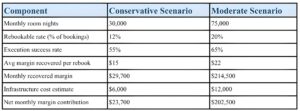
To make the internal case for rebooking as a margin strategy, the P&L needs to be constructed with specifics rather than approximations.
- Revenue line: The margin recovered per rebooking is the difference between the original net rate and the new net rate from the alternative supplier, minus any cancellation and re-confirmation fees charged by either supplier.
- Cost line: The cost of running a rebooking operation includes the monitoring infrastructure (rate watching against confirmed bookings), the API calls for rate lookup and re-confirmation, and the operational overhead for handling exceptions (re-confirmations that fail, cases where the price rebounds before the rebook executes).
- Break-even math: If your rebooking infrastructure costs $8,000/month to operate and your average recovered margin per successful rebook is $18, you need approximately 445 successful rebooks per month to cover the cost. At a portfolio of 50,000 room nights per month with a 15% rebookable rate and a 60% execution success rate, you generate roughly 4,500 rebooks. The cost is covered in the first 10% of volume.
The remaining 90% is pure margin recovery.
The Customer Experience Argument Is Backwards
People commonly object to proactive rebooking due to the risk of a bad customer experience: what if the rebook fails and the customer is left without a confirmed hotel? This objection treats rebooking as a customer-facing operation when it is fundamentally a back-office one.
The customer experience of a correctly executed proactive rebook is neutral. The customer’s confirmed hotel does not change. Their check-in process does not change. Their booking confirmation does not change. The only thing that changes is which supplier invoices your accounts payable team processes.
The customer experience risk arises only if the rebooking execution fails, which is why the rebooking system’s operational design should clearly decide success or failure before cancelling the original booking. You do not cancel until the replacement confirmation is in hand. This is an idempotency requirement, not a technical nicety.
Related Read: How to Avoid Poor Reviews & Ensure 5-Star Reviews on Your Hotel Booking Platform
Where Rebooking Sits in the Margin Stack
Rebooking does not replace mapping accuracy as a margin driver. It adds to it. The two work on different parts of the distribution P&L.
Mapping accuracy determines whether you correctly display, match, and price your inventory relative to supplier reality. A bad match produces wrong content, wrong pricing, and wrong room attribution. Chargebacks, refunds, and suppressed conversions measure the cost.
Explore further: Why Static Hotel Mapping Is Costing You Bookings
Rebooking operates correctly matched, correctly displayed bookings that have already been confirmed. You have already paid the cost base. The rebooking operation recovers additional margin from the same booking without changing anything for the customer.
Together, these two levers address both the quality floor and the margin ceiling of your distribution economics. Vervotech’s Profit Maximizer builds on this model: the mapping accuracy layer ensures clean inventory, and the rebooking capability continuously scans confirmed bookings to capture rate improvement opportunities before check-in.
Building the Internal Case
The internal case for rebooking as a margin strategy requires three things.
First, a measurement of the current opportunity in your portfolio. Pull 90 days of confirmed bookings and identify how often, and by how much, better rates were available from alternative suppliers in the 30 days prior to check-in. This is a historical analysis that most OTAs can run against their existing booking and rate data without any new infrastructure.
Second, a defined P&L model with conservative assumptions. The table above provides a template. Populate it with your own volume, and margin figures and stress-test the cost estimates against your engineering team’s integration assessment.
Third, ownership. Rebooking sits at the intersection of revenue management, product, and engineering. Without a clear owner, the initiative will stall in committee. The revenue team should own the P&L case. Product and engineering own the implementation. The sequencing is important: make the commercial case first, then design the implementation.
FAQs
Q: Does proactive rebooking require customer notification?
A: Generally, you do not need to notify if the hotel, room type, dates, and price stay the same. Changes like property swaps or upgrades require notification. Compliance teams should review legal rules that vary by location.
Q: What percentage of a typical OTA portfolio is rebookable?
A: Typically, 12-25% of confirmed bookings are rebookable, influenced by market mix, booking lead time, and supplier count. Longer lead times and high-demand markets usually yield higher rebooking rates due to price volatility.
Q: How does rebooking affect customer loyalty programs?
A: If loyalty credits are based on the original booking price, a rebooking that lowers costs for the OTA doesn’t reduce loyalty accrual. The program cost remains the same, and margin recovery is additional.
Q: Can you do rebooking without automation?
A: Manual rebooking is feasible at a small scale but unsustainable beyond a few hundred bookings monthly. Automation is essential for large-scale profitability.
Q: Which supplier relationships do you need before rebooking?
A: Suppliers with cancellation-and-rebook policies matching your monitoring cycle, ideally with 24-48 hour free cancellation windows, support effective rebooking within a 30-day pre-check-in period.
Q: How is rebooking success measured?
A: Key metric is recovered margin per room night, measured against the total booking portfolio. Secondary metrics include rebooking success rate, average lead time (closer to check-in captures more volatility), and supplier concentration indicating competitiveness issues.
The Margin Is Already There
Rebooking does not create new revenue from new customers. It recovers margin from transactions you have already paid to acquire. Your acquisition cost is sunk. Your customer is committed. The only question is whether the rate you are paying to fulfill that booking is the best rate available at the time of check-in.
In most portfolios, it is not. The gap between what you locked and what is available recovers margin that most OTAs simply leave on the table because they have never built the operational infrastructure to capture it.
Explore how Vervotech’s Profit Maximizer automates the rebooking monitoring and execution cycle, and what the typical margin recovery looks like in the first 90 days of operation.