

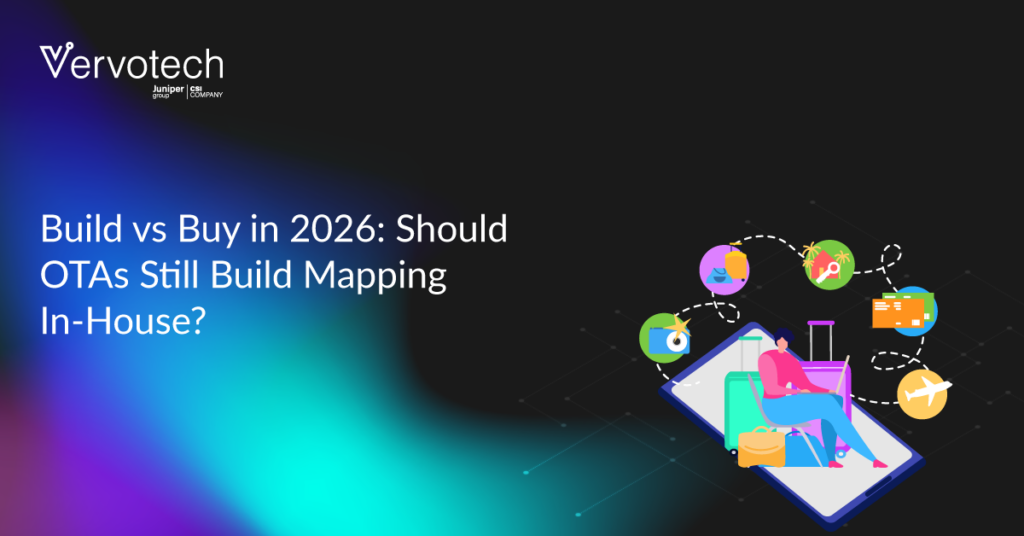
In 2026, the mapping question OTAs can’t ignore is why mapping has become a strategic decision, not just a technical one. Matching properties and rooms across suppliers now directly affects price accuracy, comparability, booking success, and traveler trust.
As inventory scales, even small mapping errors create visible problems: duplicate hotel listings, non-comparable rooms, inconsistent amenities, or failed bookings. These aren’t backend issues anymore; they show up as broken user experiences and lost conversions. With real-time expectations becoming the norm, clean hotel and room data is now core to how OTAs compete.
This raises a renewed build-vs-buy question: should OTAs still manage hotel and room mapping in-house, or is the complexity of 2026 better handled differently? Before answering that, it’s important to understand what in-house mapping actually involves today.
TL;DR
-
Hotel and room mapping is no longer a backend task. It directly impacts conversion, pricing accuracy, and traveler trust.
-
In-house mapping today involves continuous maintenance, not a one-time build. Supplier updates, room changes, and inventory growth constantly break mappings.
-
OTAs historically built mapping in-house due to limited scale and a lack of mature third-party solutions. That reality no longer holds.
-
By 2025–2026, supplier proliferation, room-level complexity, and real-time expectations have significantly increased data risk.
-
The true cost of in-house mapping is long-term engineering effort and opportunity cost, not initial development.
-
Building still makes sense for niche OTAs with limited inventory and tightly controlled suppliers.
-
For most scaling OTAs, buying mapping infrastructure delivers faster time-to-market and lower operational risk.
-
The smart shift is from owning mapping systems to owning clean, reliable outcomes.
What “In-House Mapping” Really Means Today
In-house mapping is often assumed to be a one-time exercise- connect suppliers, align IDs, and move on. In reality, managing hotel and room mapping today is an ongoing, high-maintenance operation.
For hotel mapping, teams must continuously normalize property names, addresses, geolocation data, and brand attributes across suppliers that rarely follow the same standards. For room mapping, the complexity increases further. The same room can be described differently across channels, with variations in names, amenities, occupancy rules, bed types, cancellation policies, and even pricing structures.
What makes this harder in 2026 is change. Hotels renovate, rename rooms, add new categories, or update inclusions. Suppliers refresh inventory at different speeds, and each update can quietly break existing mappings. Keeping everything aligned requires constant monitoring, rule updates, manual validation, and exception handling.
In practice, in-house mapping is less about building logic and more about maintaining accuracy at scale- something that demands sustained engineering effort, operational oversight, and domain expertise. This hidden workload is often underestimated, which is why many OTAs only realize the true cost of in-house mapping after they’ve already committed to it.
Why OTAs Historically Chose to Build Mapping In-House
For years, building hotel and room mapping in-house felt like the safest choice for OTAs. Early on, inventory sizes were manageable, supplier networks were limited, and room structures were relatively simple. Internal teams believed they could maintain better control over data quality, customization, and business rules.
Another factor was necessity. Mature third-party mapping solutions didn’t really exist, especially for room-level comparability. OTAs had little choice but to build their own systems to support search, pricing, and booking flows.
Cost also played a role. In-house mapping appeared cheaper on paper, particularly for growing OTAs with strong engineering teams. The assumption was that once the core logic was built, maintenance would be minimal.
That assumption held true until scale, speed, and supplier diversity started to outgrow what internal systems were designed to handle.
What Changed by 2025: The New Reality of Hotel Data
By 2025, hotel data will stop being static and predictable. OTAs began onboarding more suppliers, expanding into new regions, and supporting increasingly complex room types and rate plans. Inventory refresh cycles shortened, and real-time updates became the expectation, not the exception.
Room data, in particular, grew messier. The same room could vary across suppliers in naming, inclusions, occupancy, and cancellation rules, making clean comparability harder to achieve. At the same time, travelers became less forgiving of inconsistencies, quickly abandoning platforms that showed mismatched options or unclear pricing.
Mapping errors now directly affect conversion, parity, and trust, turning data quality into a business risk, not just a technical issue.
The True Cost of Building Mapping In-House
The highest cost of in-house mapping isn’t the initial build; it’s everything that follows. Engineering teams spend ongoing time maintaining rules, fixing mismatches, handling edge cases, and reacting to supplier changes. That effort compounds as inventory and room depth grow.
There’s also opportunity cost. Every sprint spent on mapping maintenance is a sprint not spent on features that directly improve the customer experience or drive revenue. Over time, data debt builds quietly, making systems harder to scale and more fragile.
What starts as “full control” often turns into a long-term operational burden that limits agility.
When Building Still Makes Sense (And When It Doesn’t)
Building mapping in-house can still make sense for OTAs with limited inventory, niche markets, or highly controlled supplier ecosystems. In these cases, the scale and variability are low enough to manage without excessive overhead.
However, when OTAs expand supplier coverage, increase room-level depth, or operate across multiple regions, in-house systems struggle to keep up. If mapping accuracy depends heavily on manual fixes, or if engineering teams are spending more time maintaining data than building product, it’s a clear signal.
In 2026, the question isn’t whether OTAs can build mapping internally; it’s whether that’s the best use of their time, talent, and resources.
The Buy Option: How Third-Party Mapping Has Matured
Third-party mapping solutions in 2026 look very different from the basic matching tools OTAs encountered years ago. Modern platforms now handle hotel and room mapping together, using a combination of AI, rules-based logic, and continuous learning to maintain accuracy at scale.
These solutions are built specifically for high supplier volumes, frequent inventory changes, and room-level complexity. Instead of reacting to mapping breaks, they proactively adapt as suppliers update content, add rooms, or modify attributes. For OTAs, this shifts mapping from a reactive maintenance task to a stable, managed capability.
Just as importantly, buying mapping today doesn’t mean giving up control. OTAs retain ownership of outcomes, clean, comparable inventory, without needing to own every rule, exception, or update internally.
As a result, mapping becomes an infrastructure that quietly works in the background, rather than a system that constantly competes for engineering attention.
Build vs. Buy: A Practical Decision Framework for OTAs
The build vs. buy decision is no longer philosophical; it’s operational. OTAs should evaluate it across a few clear dimensions.
First, scale: how many suppliers, properties, and room types are you managing today, and how fast is that growing?
Second, change frequency: how often does inventory update, and how quickly do mappings break?
Third, internal cost: how much engineering and operational effort is required to keep mappings accurate?
If mapping requires frequent manual intervention, slows down supplier onboarding, or pulls engineers away from revenue-driving work, the cost is already high, whether it appears on a balance sheet or not. In most cases, buying mapping accelerates time-to-market and reduces long-term risk, while building only makes sense when scale and variability are tightly controlled.
The Smarter Mapping Strategy for 2026 and Beyond
In 2026, the real question isn’t build vs. buy, it’s focus. Hotel and room mapping are essential, but they are not where most OTAs win customers. The most successful OTAs are shifting their engineering effort toward pricing intelligence, personalization, merchandising, and user experience, while relying on specialized platforms to keep inventory clean and comparable underneath.
For some, a hybrid approach may work. But for most growth-focused OTAs, fully owning mapping infrastructure no longer delivers a competitive advantage. Owning outcomes does. The smarter strategy is clear: reduce data friction, protect customer trust, and free teams to innovate where it matters most.