



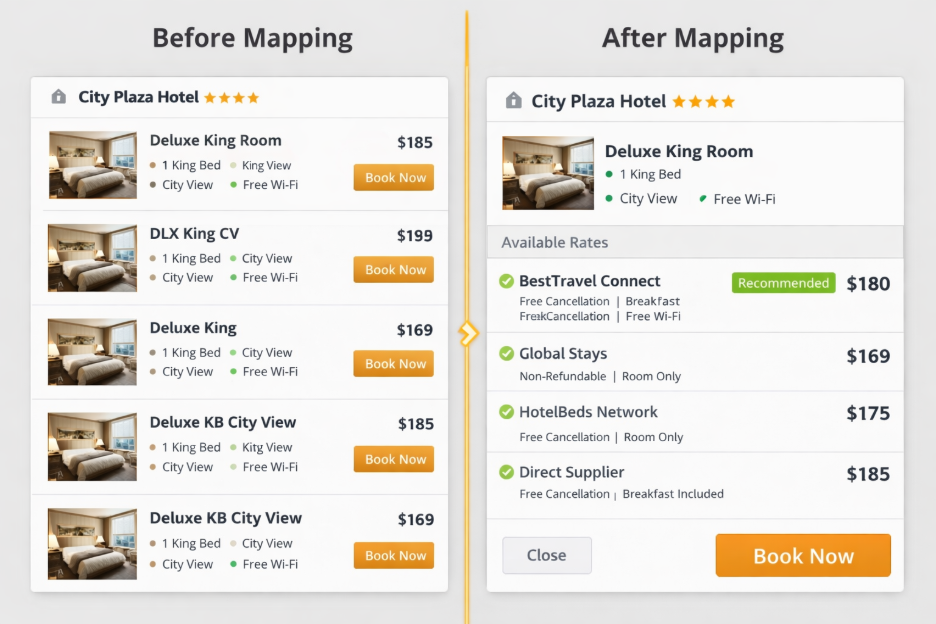
Open your hotel search results and scroll slowly.
Do you see clarity, or repetition? Two Deluxe King Rooms that look almost identical but with slightly different prices, and slightly different names. There’s no obvious way to tell if they are the same room or not.
Hotel distribution is entering a more competitive phase. A 2024 Skift Research report projects that by 2030, direct digital channels will generate more than $400 billion in hotel gross bookings, compared to $333 billion from online travel agencies. Hotels are becoming more deliberate about where and how their inventory performs.
In a time when hotel distribution control is tightening, TMCs cannot afford internal inefficiencies. Supply expansion alone is not a strategy; structural alignment is.
As a TMC, when you expand your hotel data sources through channel managers, bedbanks, and aggregators, the volume of inventory grows. What often does not grow at the same pace is data alignment. The same room comes in from multiple sources with slightly different labels, attributes, and formatting. Without accurate mapping, your system treats each version as a separate inventory. That is where inefficiency begins.
In this guide, we explore why channel manager data often fails to sync correctly and how accurate room mapping can turn your TMC supply chain into a structured, scalable advantage. Let’s begin by understanding the TMC supply chain.
How Does the Modern TMC Supply Chain Look Like?
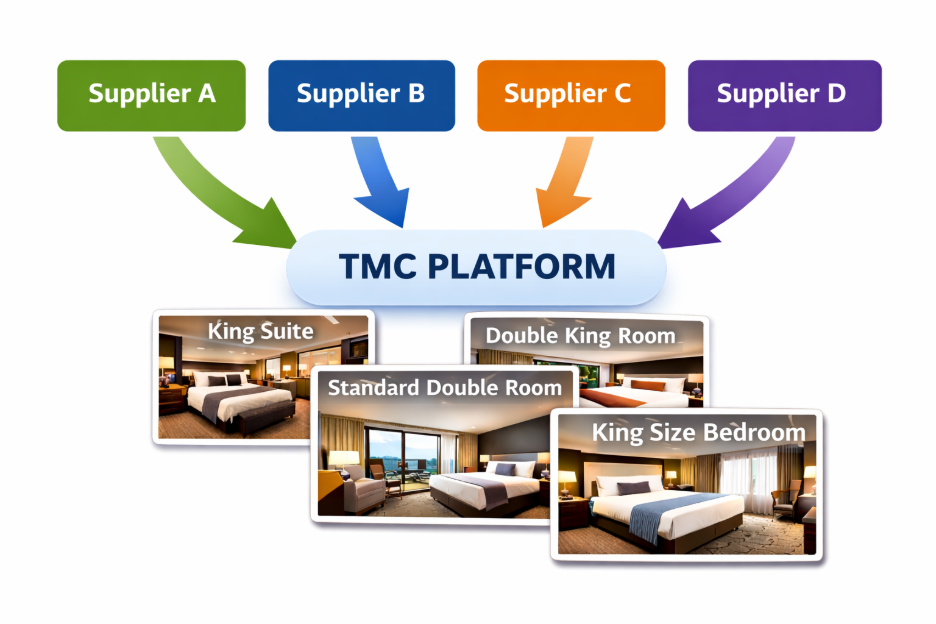
The modern TMC supply chain is layered and complex. It rarely depends on a single source of hotel content. Instead, it operates as a network of interconnected supply channels feeding into one central booking platform.
Direct hotel contracts may sit alongside channel manager integrations. Bedbanks and wholesalers add another layer. Global Distribution Systems still contribute inventory. API aggregators often sit on top of all of this, redistributing the same content in slightly altered forms.
On paper, this structure looks powerful. It promises broader coverage and better rate competitiveness. In reality, it creates an overlap. The same hotel inventory often travels through multiple pipelines before reaching your platform.
Imagine one Deluxe King Room in a business hotel. That room may come directly from the hotel’s channel manager. It may also appear via a wholesaler. It may show up again through a reseller connected to the same channel manager. Each source might structure the room data differently. The room name might vary slightly, amenities may be formatted inconsistently, and occupancy rules might not be standardized. Your system receives all of this and attempts to display it logically. Without accurate room mapping, it simply lists each record as a separate inventory.
From a traveler’s perspective, the interface starts to look repetitive and confusing. From a commercial perspective, your rate comparison engine loses clarity. From an operational perspective, reconciliation becomes painful.
The more sources you integrate with, the harder it becomes to keep room information consistent across the board. This is where the sync problem begins.
The Sync Problem: Why Channel Manager Data Doesn’t Automatically Align
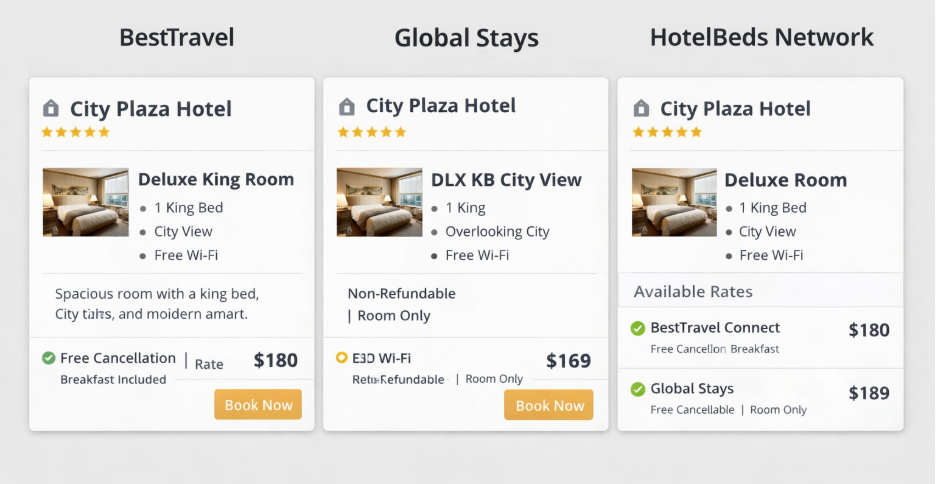
Channel managers are essential for hotel distribution. They allow hotels to update availability and rates across multiple distribution channels from one central system. That efficiency is critical for hotels. However, standardization is not their primary concern.
Hotels frequently rename room categories for branding or internal restructuring. Abbreviations differ across systems. Regional language variations introduce subtle inconsistencies. One supplier may list “Deluxe King City View” while another lists “DLX King CV.” A third might shorten it further. Structurally, they represent the same product. Digitally, they look different.
Room attributes create another layer of complexity. Bed configurations may be stored as free text in one feed and structured data in another. Room size may be missing from one supplier. Amenities may appear in inconsistent formats. Cancellation rules and meal inclusions might be bundled differently depending on the source.
When your system relies on room names alone for matching, misalignment becomes inevitable. Identical rooms fail to merge. Similar-sounding rooms with different attributes may get incorrectly grouped. The result is duplication, pricing confusion, and booking friction.
No universal room taxonomy governs the hospitality industry. Every supplier speaks its own dialect. Expecting automatic alignment across all feeds is unrealistic. Room mapping functions as the translator across these dialects. Without it, your supply chain remains fragmented.
Now that the misalignment is clear, the next question becomes practical. If channel manager data does not naturally align, what actually fixes it? More integrations will not solve it. More supplier contracts will not solve it either. Let’s explore how proper mapping turns supply chaos into operational control in the next section.
Explore how Tripjack recorded a 30% increase in conversion rate with Vervotech’s Room Mapping API.
How Accurate Room Mapping Optimizes the TMC Supply Chain
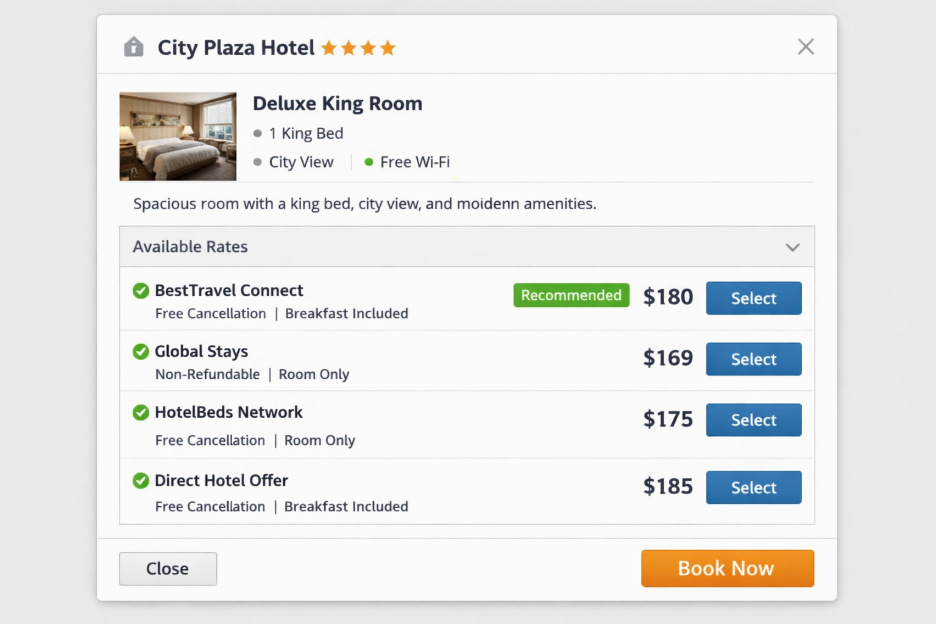
Accurate room mapping brings structure to chaos. It transforms scattered supplier records into consolidated, comparable inventory. That structural improvement has ripple effects across your entire organization.
- First, duplicate listings disappear.
When identical rooms are merged correctly, travelers see a single room category with multiple rate options. The booking interface looks clean and intentional rather than cluttered. Decision-making becomes easier because comparisons are logical.
- Second, rate optimization becomes meaningful.
True price comparison only works when the underlying products are identical. Accurate mapping ensures that your system compares like with like. Once that alignment is in place, you can intelligently select the best supplier based on margin, reliability, or negotiated preference.
- Third, operational friction reduces significantly.
Incorrect room bookings drop because travelers choose from consolidated listings. Fewer discrepancies mean fewer support tickets. Finance teams encounter fewer reconciliation challenges when invoices align with expected room categories.
- Finally, client trust strengthens.
Corporate clients may not understand room mapping as a technical concept, but they immediately recognize a clean, reliable booking interface. Confidence builds when the platform feels structured and transparent. Room mapping is not cosmetic. It directly influences revenue, efficiency, and reputation.
The benefits sound compelling- cleaner search results, fewer duplicates, better margins, and less operational clutter. But improvements do not happen automatically. Room mapping needs discipline, not improvisation. A structured implementation approach ensures long-term stability instead of temporary fixes. The next section breaks down exactly how to build that structure in a practical, scalable way.
A Step-by-Step Framework to Sync Channel Manager Data with Accurate Room Mapping
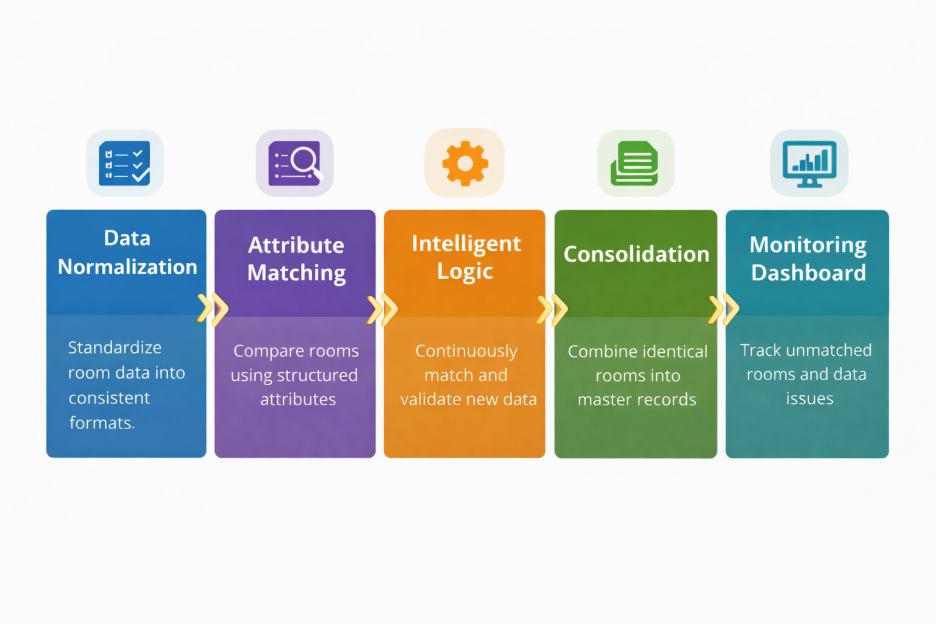
Room mapping cannot rely on quick fixes or occasional manual cleanups. As supplier data keeps flowing in and room categories keep evolving, inconsistencies will continue to surface. A stable supply chain requires a structured, repeatable approach. Data must be cleaned, compared correctly, consolidated intelligently, and monitored continuously.
The steps below outline a practical framework to sync channel manager data with accurate room mapping in a scalable way.
Step 1: Normalize All Incoming Supplier Data
Effective room mapping begins with data normalization. Raw supplier data arrives in inconsistent formats. Standardizing room names, bed types, occupancy details, amenities, and other attributes creates a consistent foundation. Clean input data dramatically improves matching accuracy.
Step 2: Shift from Name Matching to Attribute Matching
Once normalization is in place, attribute-based comparison must replace simple name matching. Bed configuration, maximum occupancy, room size, and view type provide stronger matching signals than text labels alone. Similar names do not guarantee identical products. Matching logic must examine structured attributes to determine equivalency.
Step 3: Implement Continuous Matching Logic
Intelligent matching logic should operate continuously rather than as a one-time project. Hotel inventory evolves. Room categories change. New suppliers enter the mix. Matching systems must constantly re-evaluate new data against existing master records. Automation ensures scalability, while periodic manual validation safeguards quality.
Step 4: Consolidate Matched Rooms into Master Records
After accurate matching, consolidation becomes critical. Identical rooms from different suppliers should appear under a single master listing. Multiple rates can be displayed beneath that consolidated entry. This approach maintains backend complexity while delivering frontend simplicity.
Step 5: Monitor Mapping Health Continuously
Ongoing monitoring ensures long-term stability. Dashboards tracking unmatched rooms, duplicate spikes, and room-related booking disputes provide early warning signals. Supply chains shift constantly. Mapping logic must adapt in real time.
This framework is only as valuable as the results it delivers. The real question is simple: is your supply chain actually performing better after implementation? Room mapping should not remain a backend improvement that only technical teams notice. So, to understand whether your mapping strategy is working, you need measurable indicators that connect data alignment to business outcomes.
Let’s look at the five KPIs that truly matter.
5 Important KPIs to Track After Implementing Accurate Room Mapping
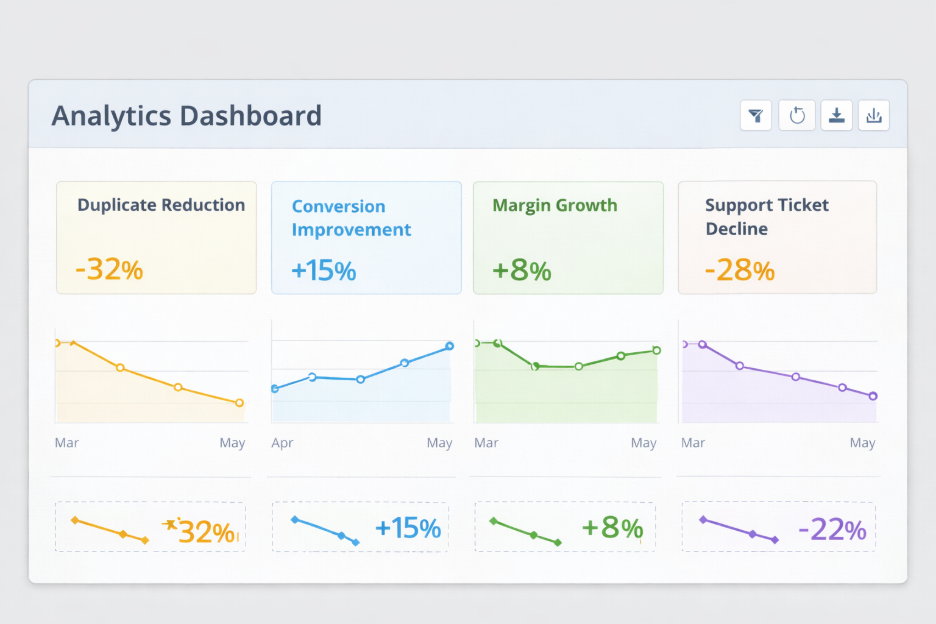
Measurement determines whether your optimization efforts are delivering tangible results. Duplicate listing reduction offers immediate evidence of structural improvement.
A visible drop in redundant room records signals successful consolidation.
Conversion rate improvement often follows cleaner search experiences. Travelers make faster decisions when options are clear and comparable. Tracking conversion before and after implementation reveals behavioral impact.
Post-booking issue rates provide operational insight. Declines in complaints related to incorrect room types indicate improved accuracy at the point of selection.
Margin performance reflects commercial benefits. Accurate mapping allows better supplier selection, strengthening profitability without increasing booking volume.
Manual intervention time within operations teams highlights efficiency gains. Reduced hours spent investigating room discrepancies translate directly into cost savings.
When these metrics move in the right direction, room mapping transitions from technical hygiene to strategic advantage.
Levar
Many TMCs chase scale aggressively. New integrations, new suppliers, new inventory streams. Growth feels tangible when numbers increase. However, unstructured growth introduces hidden friction. Duplicate listings frustrate travelers. Inconsistent data weakens trust. Operational teams carry the burden of fixing preventable issues.
Channel managers will continue to distribute hotel inventory globally. Data inconsistency will remain part of the ecosystem. Your differentiation depends on how well you interpret and structure that data. Room mapping is a foundational infrastructure. It determines whether your supply chain operates as a coordinated system or a collection of disconnected feeds.
Take a close look at your platform’s hotel search results today. Do they communicate clarity and control? Or do they reveal fragmentation beneath the surface? Optimization does not start with adding more supply. It starts with aligning what you already have.
With Vervotech’s Room Mapping API, you take control of your room data once and for all, standardizing inventory across multiple sources, eliminating mismatches, and safeguarding customer trust. Book a demo today to see how we can help.