Curated Content in Modern Travel & Hospitality
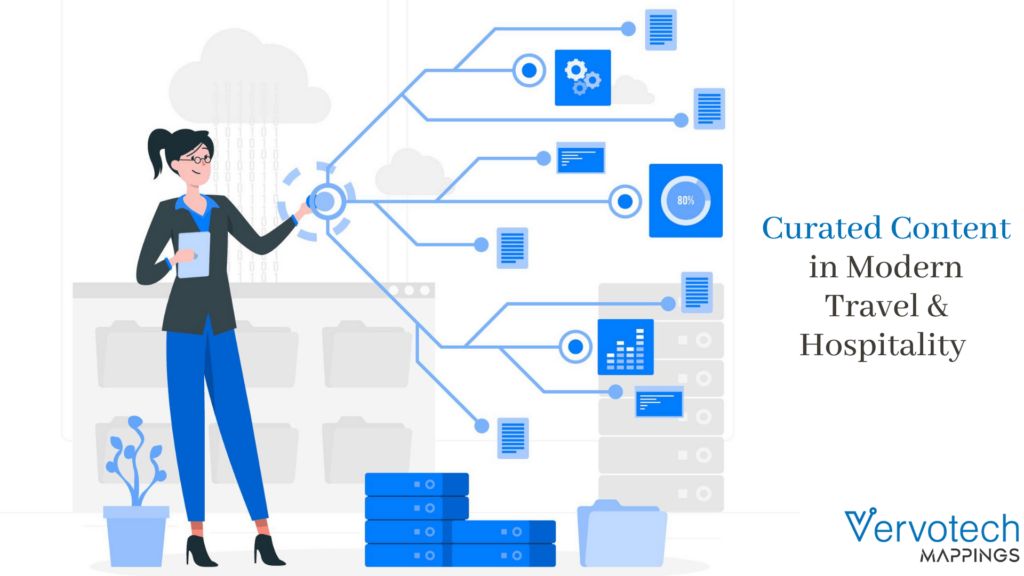
Today, one of the major challenges faced by travel companies when it comes to managing and distributing content today is the striking lack of any global standards that dictate laws for distribution. As a result, distributors and suppliers have all developed their systems for distributing content, which is a major headache for any travel agency working with multiple suppliers and trying to consolidate listings from multiple sources. Multiple suppliers may distribute the same hotel or room using different standards of distribution that leads to a lot of duplicates, inconsistencies and errors in the data. If travel agencies try to handle all their content management requirements through conventional means, their systems will quickly overload and lead to huge losses in the form of missed bookings and cancellations. Lawsuits resulting from lacklustre customer experiences and wrong listings on websites have cost companies millions over the years. With the number of bookings constantly on the rise and with customers demanding better overall experiences, it comes as no surprise that more and more travel companies are falling back upon revolutionary new technologies to alleviate their woes. Hence, considering all these factors, it had become imperative for travel agencies to understand what is content curation and make their content curation process better. So, what is Content Curation? In order to delve into the depths of content curation, we need to first understand the actual meaning of the term content. Constant information creation not only results in a growing cascade of content that is constantly being shared and re-shared all over the world but also results in large quantities of misinformation, inconsistencies and duplicates in the data that can seriously hamper its credibility. The process of identifying, segregating, managing, deduping and distributing content is known as content curation and is becoming increasingly relevant for modern businesses. Also Read – AI-Driven Content Distribution & Management in Travel and Hospitality Content Curation in the Travel & Hospitality Industry Now that we have a better idea about content and its curation, let’s discuss the types of content that travel brands need to curate. Hotel & Room Names Addresses Geolocations Amenities Value-Added Services Prices Promotions Discounts Policies Local Laws & Regulations Startups Leading the Way for Content Curation Without strict standards, content curation has quickly become not only a differentiator but a dire necessity for the industry. However, with need comes opportunities and this is exactly the reason behind the sudden influx of travel tech startups in the global market during the early 2010s. Companies started experimenting with newer techs that could completely automate the curation processes for travel businesses. One of the leading techs that found relevance was the use of AI and ML to identify, tag and dedupe the data. Not before long, companies started relying on the tech with many travel-tech startups providing both SaaS as well as PaaS based solutions to travel agencies for all their content curation, management and distribution needs. Change is the only constant and businesses worldwide need to understand this fact if they want to remain relevant, competitive, profitable and sustainable in the long run. If companies were to rely on age-old techniques to sort through such large data sets today, content curation would have forever remained a savior in distress specific to the travel industry.
SaaS or PaaS? Which Service Will Help You To Scale Your Travel Business?
New technologies, effective AI, rising costs, consolidation and the constant threat of customer attrition have put travel companies under tremendous pressure to evolve, innovate and create differentiators. It is no surprise that travel agencies are investing heavily in technologies & platforms to stay relevant and address the needs of the changing consumer. So SaaS or PaaS? Which service will help you to scale your travel business? As Travel Companies start moving to the Cloud, it is imperative to understand what is truly advantageous. Cloud computing, in its simplest form, means that the hardware and software you use for your work is provided by a company as a service. You access the so-called cloud, as opposed to services that run over the network or device of your own company. Whether you are considering SaaS or PaaS, each cloud model offers specific features and functionality. Experts say that Travel agencies need to determine how much control and customization they want to bring into their cloud services, and how much application and data security they need to have, as well as how much involvement they need to have with the cloud service provider, both in terms of applications, data, and security. With these two models available in travel technology, we are going to advocate PaaS and explain why it is relevant for travel companies compared to SaaS. 1) SaaS – Software as a Service 2) PaaS – Platform as a Service 1) SaaS – Software as a Service (SaaS), also known as white label solutions, represents the most commonly utilized option for travel companies. SaaS is a web application managed by a travel technology provider. They are usually a complete suite of software that fit a particular business model like either a Destination Management Company (DMC) or a Tour Operator. The use of SaaS applications tends to reduce the cost of owning software by eliminating the need for technical personnel to install, manage and update software, thereby reducing the cost of licensing the software. It uses third-party services such as cloud computing, cloud storage, and cloud services. Limitations: Integrations with your existing APPs: Since this software suite is hosting many clients and has a rigid architecture, a preferred 3rd party integration is quite difficult. Lock-ins and high exit barrier: Because you will be using an end to end solution, exiting out would be a matter of impacting business. Customization: SAAS platforms offer a minimum to no customizations to the service they offer. Lack of Control: The controls are limited to the versions you are on.Downtime: The downtime is controlled by the parent of the software. Also Read – Setting Legacy Code Objectives for OTAs 2) PaaS – Platform as a Service (PaaS,) allows travel agencies to design and create applications on top of these platforms. These middlewares are highly scalable with numerous advantages. PaaS is meant for developers to build and customize business hosted applications without the headache of maintaining the software. It saves you money and makes it easier for your organization to save money and be able to make the most of its cloud resources such as data centers, servers, and storage. Why we advocate PaaS: Accelerates time to build applications. Highly Scalable Helps you remain focused on building business-focused features Easy & Cost-Effective migration to the hybrid model. Would help you launch multiple businesses on the same platform Reduces the amount of needed coding Various services are provided to help with testing, and development of applications Example of PaaS: Pune based startup Vervotech Solutions Pvt Ltd, which has a PaaS solution called NEXUS. NEXUS is a true platform as a service with global customers. NEXUS serves a variety of business models like corporate travel agencies, OTAs, Consolidators. It has become the preferred PaaS solution for developers and programmers. NEXUS is a next-gen API based platform that offers a secured cloud infrastructure with 24/7 monitoring. It is the solution to the most complex problem of travel supply chain, sourcing, and distribution. NEXUS uses AI and ML to give business insights & integrates with third-party revenue management tools to optimize profits. The road ahead for NEXUS: There are the four areas where NEXUS will evolve as a PaaS: Enriching Supply: The current integrating partners in the platform are more than 60 and will continue to grow, this growth would predominantly be focused on adding more regional and specific bed-banks which are essential to the ecosystem. AI-Driven Distribution: As the search & transactional data grows on Nexus the distribution will be more effective and intelligent. Though we don’t see the distribution to be fully automated since reading huge data requires cognitive thinking skills and could vary from business to business. However, there will be iterations of builtin revenue management tools. Feature Development: NEXUS offers a complete HOW-TO guide to build travel applications on top of it. This kit is an interactive cycle of develop-deploy-manage, hence NEXUS has a list of features that can be built in to make integration with NEXUS faster. These are customer-centric features that are focused on enriching the build experience. NEXUS is becoming the preferred integration platform for travel organizations to host their supplier integrations. By doing so, they save costs, have efficient processes and focus on sales and customer experience.