


An OTA’s core promise to travelers is simple: search once, see everything. But what happens behind that search result is anything but simple.
Your platform may pull inventory from 20, 50, or 200 suppliers simultaneously. Each supplier labels hotels differently. One calls it “Hilton Garden Inn Frankfurt City Centre.” Another lists it as “Hilton GI Frankfurt.” A third has it as “HGI Frankfurt” with a different set of amenity tags. Your platform receives all three and, without accurate mapping, presents all three as separate hotels.
The traveler sees a cluttered, confusing search result. You lose the booking.
Hotel mapping for OTAs is the layer that prevents this. Here is a clear explanation of what it does, why it matters for your specific operations, and what to look for in a solution.
The OTA Data Problem
Online travel agencies operate at the intersection of many suppliers. Each supplier runs their own technology stack, naming conventions, and property ID systems. There is no universal standard.
A mid-sized OTA aggregating inventory from 30 suppliers will commonly see:
- The same property appearing under 5 to 15 different IDs across those suppliers
- Conflicting amenity lists for identical hotels (one supplier marks a property as having a pool, another does not)
- Different star ratings for the same hotel depending on the source
- Outdated or missing photos from some suppliers that make the same hotel look worse than it is
At scale, these inconsistencies compound. The hotel mapping services market has reached USD 1.42 billion globally precisely because the problem is widespread and consequential.
Without a mapping layer, your engineering team spends time on manual reconciliation. Your content team patches data quality holes one property at a time. And meanwhile, travelers on your platform see a mess.
What Hotel Mapping Does for an OTA
Hotel mapping solves the problem by creating a unified identifier for each physical property, regardless of what different suppliers call it.
Here is how the process works at an operational level:
- Data normalization. Incoming supplier feeds are standardized into a consistent format. Field names, address structures, coordinate formats, and amenity labels are aligned.
- Property matching. The system compares incoming records against a master database, evaluating multiple signals (name, address, GPS coordinates, phone number, images) to determine if an incoming record is a new property or an existing one.
- Matched records are merged under a single canonical property ID. All supplier codes that refer to the same physical hotel map to that one ID.
- Master data enrichment. The unified listing is populated with the best available content from across all supplier sources.
- Continuous sync. As suppliers update their records, the mapping layer re-evaluates and propagates changes downstream.
The result is a clean, unified hotel inventory that your booking engine can actually work with.
How Duplicate Listings Hurt Conversion
The connection between data quality and conversion rates is direct.
When a traveler searches for hotels in Bangkok and sees the same Marriott property listed three times at slightly different prices with different photos, several things happen:
- Confusion creates hesitation. The traveler is not sure which listing to trust.
- Price comparison breaks down. The traveler cannot tell if the price difference reflects a different rate or a different property.
- The booking experience looks unprofessional. Duplicate listings signal a platform that is not fully in control of its own inventory.
- Some travelers abandon the search. Rather than figure it out, they go to a competitor platform.
Online booking represents 82% of travelers’ preferred booking method, and the mobile share is over 55%. On a small mobile screen, a cluttered inventory is even harder to navigate.
Platforms that have addressed duplicate listings report measurable improvements in conversion rates. The inverse is also true: poor data quality is one of the most common causes of booking abandonment that goes undetected because it looks like normal drop-off in your analytics.
Also Read: 5 Most Common Operational Pitfalls Faced by OTAs
The Supplier Onboarding Challenge
Supplier onboarding is where hotel mapping has the most visible operational impact on OTA growth.
When you add a new supplier, you need their entire hotel inventory mapped against your existing database before those properties can go live. Without an automated mapping layer, this process involves manual matching, quality review, and iterative correction.
According to Vervotech’s research, 35% of OTAs take two to three weeks to onboard new suppliers and get updated content live on their platform. That delay has a real cost: you are paying for a supplier relationship that is not yet generating bookings.
A well-integrated dynamic mapping system can reduce this timeline to under 24 hours. The supplier’s feed comes in, the system automatically matches their properties against the master database, and new inventory is available without a manual bottleneck.
This acceleration matters at every stage of an OTA’s growth. Early on, it allows a startup to onboard suppliers without proportionally growing an operations team. At scale, it allows rapid expansion into new markets where regional supplier networks need to be integrated quickly.
What an OTA Needs from a Mapping System
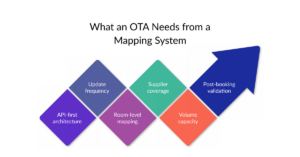
The requirements for hotel mapping at an OTA are more specific than for other buyer types. Here is what to evaluate:
Volume capacity. OTAs handle large inventories. The mapping system must handle millions of records without performance degradation.
Update frequency. Supplier content changes daily. A mapping system that updates only periodically will create lag between a supplier update and what travelers see on your platform.
Room-level mapping. Property-level deduplication is the foundation. But at the room level, the same “Superior King Room” comes in from different suppliers under different names and with different attribute sets. Room mapping adds a second layer of standardization that directly improves how travelers shop and compare.
Post-booking validation. A mapping error that reaches a completed booking is the worst outcome. Some platforms offer post-booking mapping checks to catch mismatches before they reach the guest.
Supplier coverage. The more suppliers your mapping partner already covers, the faster your onboarding cycles.
API-first architecture. OTA platforms are engineering-driven. The mapping layer needs clean, well-documented APIs that integrate into your existing booking flow without custom work.
How Vervotech Supports OTA Operations
Vervotech’s hotel mapping platform is built with OTA operations in mind. The system connects to 600 or more suppliers globally and maintains 99.999% accuracy through continuous AI-powered matching. Updates run multiple times per day, so content changes propagate quickly.
For supplier onboarding, the platform allows new suppliers to be integrated within 24 hours. For room-level deduplication, Vervotech’s Room Mapping API uses NLP and machine learning to standardize room types across all connected sources.
The platform also includes post-booking mapping validation, which catches mapping errors after booking but before they reach the guest, reducing complaints and cancellations. Tripjack, one of India’s major OTAs, recorded a 30% increase in conversion rate after implementing Vervotech’s Room Mapping API.
Pricing starts at $399 per month for hotel mapping and $449 per month for room mapping, with no usage-based charges or hidden fees.
Read more: Vervotech for OTAs
Conclusão
Hotel mapping is not a back-office function for OTAs. It is a direct lever on conversion, supplier onboarding speed, and traveler trust. The platforms that treat it as infrastructure rather than an afterthought tend to have cleaner search results, faster supplier relationships, and fewer post-booking complaints.
The requirements are specific: high accuracy, multiple daily updates, broad supplier coverage, room-level capability, and clean API integration. If your current mapping setup cannot reliably deliver all of these, the gap is worth closing.
FAQs
What is hotel mapping for OTAs?
Hotel mapping for OTAs is the process of consolidating hotel property records from multiple suppliers into a unified database, eliminating duplicates and standardizing content so travelers see consistent, accurate listings.
Why do OTAs need hotel mapping software?
OTAs aggregate inventory from many suppliers, each using different property IDs and naming conventions. Without mapping, the same hotel appears as multiple listings. This creates duplicate search results, pricing confusion, and lower conversion rates.
How does hotel mapping affect OTA conversion rates?
Duplicate listings confuse travelers and erode trust in the platform. When duplicates are eliminated and content is standardized, travelers can compare hotels confidently, which directly improves booking conversion.
How long does supplier onboarding take with hotel mapping software?
Without an automated mapping system, onboarding a new supplier can take two to three weeks. With a dynamic AI-powered mapping layer, the same process can complete in under 24 hours.
What is room mapping and why do OTAs need it?
Room mapping operates at the room type level, standardizing room categories across suppliers. For OTAs, this means travelers can compare “Deluxe Double Room” consistently across all suppliers rather than seeing 12 variations of the same room type.
What is the pricing for OTA hotel mapping software?
Pricing varies by vendor. Vervotech offers hotel mapping starting at $399 per month and room mapping starting at $449 per month, with no usage limits or hidden fees.