


Metasearch has made your customer acquisition math harder every year. CPAs on Google Hotel Ads and Trivago have climbed steadily as hotel chains bid more aggressively for direct traffic. The OTAs and bedbanks that built their volume on metasearch now find that the economics they modelled three years ago no longer hold.
Most distribution teams respond to this with one of two moves: they reduce metasearch spend and accept lower volume, or they absorb the higher CPA and watch net margin compress. There is a third option that most teams have not fully priced into their models. Rebooking revenue, generated between booking confirmation and check-in, can partially or fully offset the CPA drag from metasearch. When you run this math correctly, the channel looks different.
Here is how the commercial model works.
Why Metasearch Margin Is Thinner Than Your P&L Suggests
Your metasearch CPA is a visible number. The commission you pay and the bid cost you absorbed are right there in the channel report. What is less visible is the net margin after accounting for supplier rate, platform fee, payment cost, and customer service load.
For a mid-market OTA running a typical blended margin of 8-12% on hotel bookings, a metasearch CPA of $18-22 on a $200 booking eats 9-11 percentage points before anything else is counted. That leaves almost nothing for the exceptions: a mismatch, a rebook request, or a payment dispute.
The average OTA now generates 15-30% of hotel bookings through metasearch. If your total hotel booking volume is 100,000 bookings per month and a quarter of those come from metasearch, the CPA drag on that cohort runs into the millions annually.
Also Read: Rebooking Economics: The Overlooked Margin Lever
The Rebooking Window That Metasearch Creates
Here is what the channel math misses. Metasearch customers book early. The comparison nature of the channel means most metasearch-originated bookings are made 14 to 60 days before check-in, which is longer than the average booking window on direct or OTA organic.
That window is where rebooking operates.
Between booking confirmation and check-in, rates move. Properties reprice their inventory, wholesale allocations shift, and promotional rates get loaded then pulled. A booking made at $200 in week one may have a comparable room available at $155 in week three. If your system is watching that window and routing a rebook, the recovered margin on that one transaction can be $30 to $40.
The customer sees no change. The booking stays in place. Your P&L absorbs a margin recovery that was sitting in an open window.
The Arbitrage Model: Illustrative Numbers
The table below shows how rebooking recovery stacks against metasearch CPA for a hypothetical OTA running 25,000 metasearch-originated hotel bookings per month. These are illustrative figures, not based on any specific customer dataset.
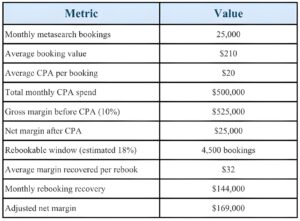
The rebooking recovery in this model does not eliminate the metasearch CPA problem. It does change the math from a near-zero net margin position to a viable channel contribution. On a 25,000-booking cohort, the difference is $144,000 per month, or roughly $1.7 million annually.
That is not a rounding error.
What Determines Rebookable Rate
Not every booking in the metasearch cohort is rebookable. The factors that determine which bookings generate recovery opportunities are:
- Booking lead time: Bookings made more than 21 days before check-in have more rate movement to capture. Metasearch customers over-index here.
- Rate plan flexibility: Non-refundable bookings on the supplier side constrain rebooking options. If your room-level mapping is clean, you can identify which supplier rate plans allow substitution without penalty.
- Property volatility: Mid-tier urban hotels, resort properties during shoulder seasons, and properties with dynamic yield management repricing more aggressively. These generate more rebooking windows.
- Inventory overlap: The more suppliers your mapping system covers, the higher the probability that a lower rate for an equivalent room is available somewhere in your supply network.
Also Read: Boost Your OTA’s Profitability: The ROI of Investing in Hotel Mapping
Where Mapping Quality Becomes a Constraint
Rebooking is only as good as the match confidence behind it. If your hotel mapping system returns a near-match instead of a true match, a rebook route may substitute a different property category, a different room type, or a rate plan with different cancellation terms.
That is not a rebooking win. That is a customer service problem scheduled for delivery.
The systems that generate consistent rebooking recovery are built on top of a mapping infrastructure that resolves supplier property IDs to a single canonical record, then maps room types to a standardized attribute set. Without that foundation, the system cannot confidently identify that a room at Supplier B is genuinely equivalent to the room already booked at Supplier A.
Vervotech’s Profit Maximizer is designed around this constraint. The rebooking logic runs on top of the same AI-powered mapping layer that powers property and room deduplication, which means the confidence threshold for equivalence is based on real attribute comparison, not fuzzy name matching.
Why This Changes the Metasearch Decision
The standard metasearch bidding decision is a CPA-versus-conversion-rate calculation. You bid until the margin disappears and then stop. With rebooking economics in the model, the margin floor changes.
If your expected rebooking recovery on a metasearch cohort is $5 to $8 per booking, that is $5 to $8 of additional CPA headroom on every booking. For channels where you were previously break-even or slightly negative, this headroom changes the bid decision.
It also changes the conversation with your revenue team. Metasearch is not just a volume channel. For operators with functioning rebooking infrastructure, it is a channel that generates a predictable margin recovery stream on top of the initial transaction.
Building the Internal Business Case
If you want to run this analysis for your own distribution, the calculation has three inputs:
- Your metasearch booking volume & average booking value: Pull from your channel attribution report, segmented by lead time.
- Your current net margin on metasearch after CPA: This is often negative or near-zero for high-competition corridors.
- An estimate of your rebookable rate: Start with a conservative 12-15% of metasearch bookings with lead time over 21 days. Your actual rate will depend on your supplier mix and property type distribution.
Multiply your rebookable volume by an average recovery of $25 to $40 per rebook. Compare that to your annual CPA spend on the same cohort. The ratio is your business case.
Most teams that run this calculation for the first time find that the rebooking recovery is large enough to reopen bidding decisions they had already closed.
FAQ
Q: What is metasearch arbitrage in the context of hotel bookings?
A: Metasearch arbitrage refers to the practice of capturing margin differences between the price paid at booking and lower rates available on the same property between booking and check-in. The metasearch channel creates this opportunity because its customers tend to book further in advance, leaving a longer window for rate recovery.
Q: How much can rebooking offset metasearch CPA?
A: This depends on your booking volume, lead time distribution, and supplier mix. Illustrative models suggest that rebooking recovery of $5 to $8 per metasearch booking is achievable with functioning infrastructure. On high-volume metasearch cohorts, that translates to meaningful annual margin recovery.
Q: Does rebooking affect the customer experience?
A: No. A properly executed rebook replaces the supplier booking behind the scenes without changing the customer’s confirmation, room type, or check-in details. The customer experience is identical.
Q: What mapping quality is required for rebooking to work reliably?
A: Room-level mapping with standardized attribute comparison is the minimum requirement. Property-level mapping alone is insufficient because it cannot confirm that the substitute room is genuinely equivalent in bed type, view, floor level, and cancellation policy.
Q: Can rebooking be applied to all metasearch bookings?
A: No. Bookings with less than 7 days to check-in, non-flexible supplier rate plans, or high-confidence static pricing offer limited rebooking opportunities. Effective systems filter for the rebookable cohort and concentrate monitoring resources there.
Q: How does this model change metasearch bidding strategy?
A: When rebooking recovery is modelled as a per-booking margin contribution, the effective CPA ceiling rises. Channels that were break-even on a pure transaction basis become margin-positive when the post-booking recovery is included. This may justify reopening bids on previously suppressed corridors.
Why This Math Belongs in Your Distribution Model
Metasearch spend is not going away. The channel’s reach is too large and its intent signal too strong for most OTAs and bedbanks to exit. What can change is how you account for the full economics of the channel.
The booking transaction is not the last moment in the P&L. The window between booking and check-in is where rates move, and where rebooking systems recover margin that would otherwise stay with the supplier. For distribution teams running on thin metasearch margins, that window is worth modelling carefully.
Explore Vervotech’s Profit Maximizer to see how rebooking infrastructure is built on top of mapping accuracy.