



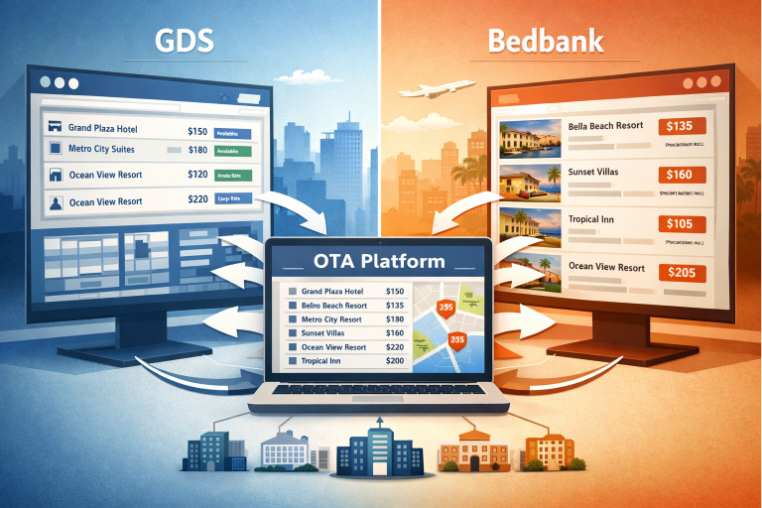
According to industry estimates, most mid-to-large OTAs now depend on multiple hotel supply sources instead of a single channel. The reason is simple. One source never gives you complete coverage, competitive pricing, and consistent availability at the same time.
This is the daily reality for many OTAs and DMCs running on hybrid supply. GDS and bedbanks both fuel growth, but when their data is not aligned, they quietly create confusion, pricing inconsistencies, and operational strain.
While relying only on GDS limits rate competitiveness in leisure markets, relying only on bedbanks limits corporate and chain coverage. This is why a blended, or hybrid model gives you power, but a poorly managed blended model gives you chaos.
The question is not whether to use both. The real question is this: “How do you make different sources speak the same language inside your system?” That is where hotel data standardization becomes critical.
This guide breaks down how to standardize multi-source inventory, so growth feels controlled, not chaotic.
GDS vs. Bedbanks: What Actually Differs at the Data Level
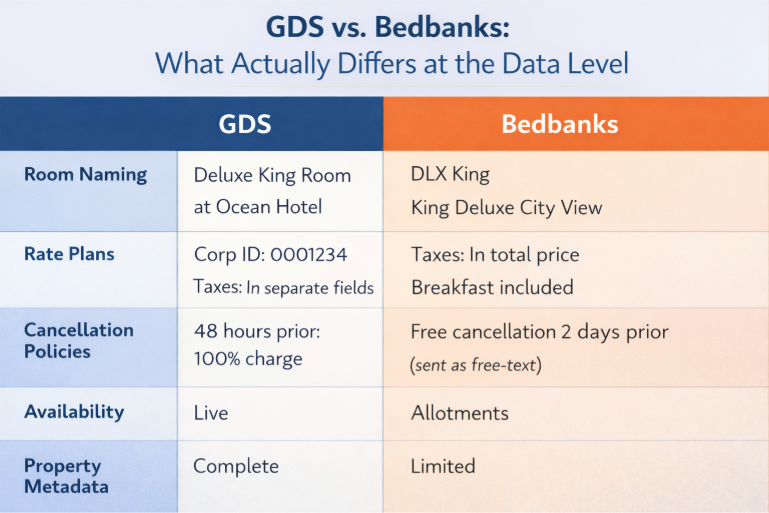
Most conversations about GDS vs bedbanks stay at the surface. The real differences live inside the data. Let’s look at some of the major ones:
- Room naming: A GDS may list a room as “Deluxe King Room.” A bedbank may list “Deluxe Room King Bed,” “DLX King,” or “King Deluxe City View.” Even though it is the same physical room with different labels, your system sees them as two separate products unless they are mapped correctly.
- Rate plans: GDS rates often carry corporate codes, negotiated identifiers, and structured inclusions. Bedbank rates may bundle breakfast differently or treat taxes in separate fields. Some include service charges. Others push them into total pricing.
- Cancellation policies: GDS content may follow structured penalty windows. Bedbanks sometimes send free-text descriptions. Comparing them becomes difficult when formats are inconsistent.
- Availability behavior: GDS inventory often reflects live availability from chains. Bedbanks operate on contracted allotments or dynamic sourcing. One may show “on request.” The other shows confirmed availability.
- Property content depth: Images, amenities, geocodes, star ratings, and descriptions may not align. One source may include complete metadata. Another may lack essential fields.
All these differences seem small individually, but when combined, they create friction inside your booking flow. Data standardization does not mean forcing both sources to behave identically. It means translating both into a clean internal structure so your system can compare, rank, and display correctly. Without that layer of normalization, your search results become inconsistent.
Where Things Break: The Most Common Standardization Gaps
Most problems do not begin at the booking stage. They begin with ingestion and mapping, slowly chipping away at your operational efficiency. Some of the most common gaps that OTA and DMC owners encounter are:
- Duplicate listings confuse customers. Two prices for the same hotel raise suspicion. Agents waste time explaining why one “Deluxe Room” costs more than another “Deluxe Room.”
- Tax inconsistencies distort price comparison. One rate appears cheaper until checkout reveals hidden charges. Refund disputes follow.
- Manual mapping might feel manageable when you have 5,000 hotels. Scale that to 100,000 properties across multiple suppliers. Manual fixes stop being sustainable.
- Support teams then become the shock absorbers of poor data structure. Refunds, complaints, booking errors, and supplier escalations increase.
- Revenue leakage often hides inside these gaps. Lower-ranked listings, wrong room selection logic, and inconsistent margin rules directly affect profitability.
Fixing these issues requires structural thinking, not patchwork solutions.
What Does a Good Hotel Data Standardization Framework Look Like
So what does “good” actually look like when it comes to hotel data standardization?
It starts with one simple principle- one hotel should exist only once inside your system. No matter how many suppliers send that property, your platform should map everything back to a single master record. If your team still sees the same hotel appearing twice under slightly different names, the framework is not strong enough.
Next comes room-level clarity. “Deluxe King,” “King Deluxe,” and “DLX King City View” should not confuse your system. A solid framework intelligently groups equivalent room types so customers and agents compare like with like. Otherwise, your search results become cluttered and misleading.
Rate logic needs structure, too. Taxes, meal plans, service fees, and inclusions must convert into a consistent internal format. If one supplier sends net rates and another sends sell rates, your system should normalize them before comparison. Customers should never discover pricing surprises at checkout because the backend data was inconsistent.
Cancellation policies also require formatting discipline. Free-text rules from one supplier and structured penalty windows from another must translate into standardized fields. Your system should understand what “free cancellation until 48 hours prior” means without human interpretation.
Then comes prioritization logic built into the framework itself. When the same room arrives from multiple sources, your system should automatically decide which one to surface based on predefined commercial rules, not random order.
Finally, a good framework is not static. It continuously absorbs new suppliers without breaking. Adding inventory should feel controlled, not chaotic. If onboarding a new bedbank still requires weeks of manual cleanup, your structure needs reinforcement.
Standardization is not about perfection; it is about predictability. When your inventory behaves consistently across destinations and suppliers, your operations stabilize, your agents gain confidence, and your business scales without hidden friction.
Also Read: Cleaning & consolidating Hotel Data with Unified Content Workflows: Do’s and Don’ts for Bedbanks.
Source Prioritization: Not All Inventory Should Be Treated Equally
Do you really want your system to treat every supplier the same way?
Many OTAs and DMCs plug in multiple sources and let the lowest price float to the top. It feels logical. Cheaper rate wins. But here is the uncomfortable truth- the cheapest rate is not always the smartest business decision. Think about your core markets. Corporate-heavy city? Structured GDS rates with clearer policies may convert better and create fewer post-booking issues. Leisure destination? Bedbanks often bring stronger pricing and wider independent hotel coverage. Different markets demand different winners.
Now ask yourself- “Which supplier gives you fewer booking failures? Which one triggers fewer refund disputes? Which one consistently confirms faster?” Reliability builds trust, especially for DMCs dealing with agents and end clients. A failed confirmation can cost you more than a small price gap.
What about margin? If two rates are almost identical but one gives you a better commercial return, why would you ignore that? Allotment contracts also matter. Unused inventory eats into profitability quietly.
Inventory is not just something to display; it is a commercial lever. If you are not actively deciding which source should win in each scenario, your ranking logic is deciding for you. And chances are, it is not thinking about long-term growth.
Also Read: Optimizing Supplier Connectivity: How Clean Hotel Data Increases Booking Efficiency
Your Takeaway: Hybrid Supply Is Not the Problem
Hybrid supply is not the problem. Poor mapping is. GDS and bedbanks both add value. One brings structure and corporate reach. The other brings depth and pricing flexibility.
Conflict appears only when systems fail to translate differences properly. Ask yourself a few questions:
- Do duplicate properties appear frequently?
- Do agents struggle to explain price differences?
- Do support tickets often involve mismatched policies?
- Do margin calculations vary across suppliers?
If the answer is yes to even one, you must prioritize hotel data standardization. Growth today is not just about signing more contracts. Growth depends on how intelligently you manage what you already have. Even though inventory standardization does not feel glamorous and rarely ever appears in marketing brochures, it determines how efficiently your business scales.
Hybrid supply is here to stay. A structured hybrid supply is what separates growing OTAs and DMCs from stressed ones. The real competitive advantage lies in turning multiple supplier feeds into one coherent system that works quietly in the background while you focus on expansion.
That is where long-term stability begins.
If managing GDS and bedbank data feels heavier each time you add a new supplier, let’s change that. Schedule a demo to see how Vervotech helps OTAs and DMCs map, deduplicate, and standardize hotel inventory with AI-native technology.