




Hello there!
Since you’re here, chances are that you’re looking for a hotel mapping API for your online travel business, or maybe you’ve already evaluated a few options but still can’t make the final decision.
We get it! Choosing the right hotel mapping API is one of the biggest and probably the hardest decisions you’ll make for your online travel business. After all, not all APIs are created the same. But with so many mapping providers promising “the best accuracy” and “AI-powered solutions,” how do you really know which one’s the right fit for your business?

In this blog, we’ll walk you through all the factors that matter when choosing a hotel mapping API and help you identify what makes a mapping solution truly reliable for your online travel business.
Before we dive into what makes a great mapping API, let’s take a moment to understand why this decision matters so much in the first place and how the right choice can directly impact your business performance.
TL; DR
- A reliable hotel mapping API is the driving force behind any travel platform because it ensures clean, consistent, and accurate hotel data across multiple suppliers.
- Choosing the wrong hotel mapping API can lead to duplicate listings, incorrect mapping, and poor traveler experiences that directly impact conversions.
- Key challenges in selecting the right hotel mapping API include scalability issues, low match accuracy, poor support, slow updates, and hidden data inconsistencies.
- The best hotel mapping APIs offer automation, continuous learning, high precision, and easy integration.
- Factors like budget, supplier volume, data quality needs, scalability, and social proof should guide your decision.
- Before you finalize a hotel mapping API, use an evaluation checklist to compare mapping accuracy, integration effort, and vendor credibility.
- Vervotech’s Hotel Mapping API ensures 99.999% data accuracy and is one of the leading hotel mapping solutions.
Why Choosing the Right Mapping API Matters
Messy hotel data isn’t just a backend issue; it’s what your end customers interact with when they land on your business platform. It creates confusion, impacts decisions, affects their experience, and even distorts their trust in your platform.
That’s why choosing the right hotel mapping api- one that can ensure you the highest quality of hotel data- one that helps you win your customers’ trust & experience, matters. The accuracy of your data shapes how travelers see your brand, how partners work with you, and how confidently your platform grows.
But knowing what to look for is one thing, and finding a solution that actually lives up to it is another. Many travel businesses stumble not because they don’t understand the value of mapping, but because they overlook the red flags during evaluation. Let’s look at some of the most common challenges teams face when choosing a Hotel Mapping API.
What Are the Most Common Challenges When Choosing the Right Hotel Mapping API?
On paper, most hotel mapping APIs look similar- accurate, automated, AI-powered. But once you dig deeper, the differences become clear. Many travel businesses realize too late that their chosen solution can’t scale or deliver consistent quality. Here are a few common challenges to look out for.
- Overpromised Accuracy, Underwhelming Results
Many mapping providers claim near-perfect accuracy, but when tested with real-world data, duplicates, mismatches, and missing fields start showing up. Without transparent accuracy metrics, it’s easy to buy into inflated claims. - Limited Data Coverage Across Sources
Some APIs work well with a few suppliers but struggle to scale across global bedbanks, wholesalers, or OTAs. Inconsistent coverage leads to fragmented hotel listings and incomplete inventory. - Poor Integration Support and Documentation
A great API is only as good as how easily your team can integrate and maintain it. Limited documentation, unstable endpoints, or slow support can stall projects for weeks. - No Continuous Updates or Data Refresh
Hotel data changes constantly- new properties, rebrands, closures. Without frequent updates or real-time sync, your listings quickly become outdated, creating poor customer experiences.
Once you know what can go wrong, it’s easier to focus on what matters most, or what you should actually look for in a reliable Hotel Mapping API. Let’s start with features that are absolutely non-negotiable in a good Hotel Mapping API.
What Features to Look for in a Hotel Mapping API?
Selecting the right accommodation mapping partner is about finding a solution that can scale, maintain the accuracy of your hotel data, and reduce your team’s workflow. Finding such a solution might seem difficult, but it isn’t if you look for the right features that separate an average mapping API from a dependable one.
- Accuracy That You Can Measure, Not Assume
Don’t settle for vague claims of “high accuracy.” Look for clear benchmarks like precision rates, error margins, and validation processes. Browse through providers’ case studies to gauge the real impact on accuracy. The best APIs are transparent about their accuracy metrics and continuously refine their algorithms using real-world data.
- Global Coverage and Multi-Supplier Compatibility
Your mapping solution should unify data from multiple suppliers, bedbanks, and OTAs across regions without losing consistency. Wide coverage ensures your listings stay complete and competitive across markets.
- Continuous, Automated Data Updates
Hotel data changes fast- new openings, rebrands, closures, and amenity updates happen daily. A strong hotel mapping API continuously syncs and refreshes data, keeping your listings always current and trustworthy.
- Intelligent Enrichment Capabilities
Mapping shouldn’t just match hotels; it should enhance them. Look for APIs that enrich each listing with complete attributes: star ratings, amenities, images, geo-coordinates, and brand info to improve your customers’ booking experience.
- Easy Integration and Developer-Friendly Support
A great API doesn’t slow your tech team down. Prioritize a mapping solution with well-documented endpoints, sandbox testing environments, stable performance, and responsive technical support. The ease of integration can make or break your project timelines.
- Mapping Speed
One non-negotiable feature to look for in a hotel mapping API is the mapping speed. The faster the API processes and maps new inventory, the quicker you can display accurate hotel listings on your online travel platform.
Slow mapping speed can delay content updates, cause inconsistent availability, and miss revenue opportunities. Look for a mapping API that offers fast mapping speed, without compromising accuracy.
Industry-wide Recognition and Transparent Partnerships
Apart from the features mentioned above, there’s one additional aspect that you must clearly evaluate- industry recognition. Go with a mapping API provider with proven credibility, an established client base, and case studies that back their claims. The right partner doesn’t just sell an API; they help you succeed with it.
While features define what a mapping API can do, the real question is how well it aligns with your business needs. Let’s explore the core factors to weigh before you make your decision.
Factors to Consider When Choosing a Hotel Mapping API
Even the best mapping API on paper might not be the best fit for your business. The right choice depends as much on your internal setup- budget, supplier network, and growth goals, as it does on the API’s capabilities. There are many factors that should guide your decision. Let’s look at those:
- Your Supplier Network and Data Sources
The number and diversity of suppliers you work with directly impact the precision of mapping you need. If you’re connected to multiple bedbanks, wholesalers, and OTAs, you need an API that can handle large, varied datasets with minimal overlap. The broader your network, the stronger your mapping engine needs to be.
- Your Budget vs. Long-Term ROI
It’s tempting to pick the cheapest option, but poor mapping accuracy can quietly drain profits through duplicate listings, refund issues, and manual fixes. Think beyond upfront cost, consider how much time, effort, and lost bookings you’ll save with a more reliable solution.
- Scalability of Your Operations
If your inventory or partner list is expected to grow, your mapping API should grow with you. Scalability isn’t just about handling volume; it’s about maintaining accuracy, speed, and system stability as your data expands.
- Social Proof and Vendor Credibility
Look for proven partners with a track record in the travel industry. Case studies, client testimonials, and partnerships with major OTAs or tech providers are strong indicators of reliability. In this space, reputation isn’t built overnight; it’s earned through consistent results.
- Integration Time and Internal Tech Resources
Some APIs integrate smoothly; others can eat up weeks of developer bandwidth. Before signing up, assess your team’s technical capacity and check if the vendor offers robust documentation, sandbox environments, and responsive support. The goal is to start mapping, not debugging.
- Flexibility and Customization Options
No two travel businesses structure their data in the same way. Choose an API that allows customization, whether that’s prioritizing certain suppliers, tweaking enrichment layers, or integrating mapping logic into your own workflow. Flexibility often separates a “fit-for-now” solution from a “fit-for-growth” one.
By now, you probably have a few mapping providers in mind. But how do you separate strong contenders from good marketing? That’s where a clear evaluation checklist comes in, helping you make a confident, data-backed choice.
The Evaluation Checklist: How to Shortlist Your Mapping API Partner
Now that you know what you need, how do you verify whether a provider can actually deliver it? A well-structured evaluation process can save you months of rework and prevent data headaches down the line.
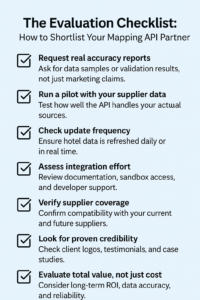
Here’s a checklist to help you shortlist mapping providers and find the one that truly fits your business needs:
- Request real accuracy reports
Ask for data samples or validation results, not just marketing claims.
- Run a pilot with your supplier data
Test how well the API handles your actual sources.
- Check update frequency
Ensure hotel data is refreshed daily or in real time.
- Assess integration effort
Review documentation, sandbox access, and developer support.
- Verify supplier coverage
Confirm compatibility with your current and future suppliers.
- Review post-sale support & SLAs
Look for fast response times and dedicated assistance.
- Look for proven credibility
Check client logos, testimonials, and case studies.
- Evaluate total value, not just cost
Consider long-term ROI, data accuracy, and reliability.
Choosing the right hotel mapping API isn’t just about ticking technical boxes; it’s about finding a partner who understands your travel business. The right solution should grow with you, not limit you.
Look for an API that brings proven accuracy, speed, and scalability to your operations, one that grows with you, not against you. Social proof and customer trust matter too; it’s what separates a short-term mapping partner from a long-term ally.
Check out Vervotech’s Hotel Mapping API, which is built with precision, backed by machine learning, and trusted by global travel brands to deliver unmatched accuracy in hotel data. Because in the world of travel, the difference between a smooth booking experience and a broken one often comes down to clean, connected data.
Schedule a free demo to see how Vervotech’s Hotel Mapping API can benefit your online travel business.
FAQs
- How does hotel mapping accuracy impact my OTA’s search and booking experience?
Accurate mapping ensures that travelers see correct hotel details, pricing, and availability, minimizing booking errors, refund requests, and customer frustration. It directly improves conversion rates and trust in your platform. - Can I integrate a hotel mapping API with my existing booking engine or PMS?
Yes, most modern APIs (like Vervotech’s) are designed to integrate seamlessly with booking engines, PMS, and supplier feeds without disrupting existing workflows. - How often should a hotel mapping database be updated?
Ideally, your provider should update and refresh mappings daily or in real time, since hotel inventories change constantly. Outdated data leads to mismatches and poor traveler experiences. - What metrics should I monitor to measure my mapping API’s performance?
Look at the match accuracy rate, data refresh frequency, duplicate reduction rate, and latency. These metrics tell you if your mapping partner is truly improving operational efficiency. - What’s the difference between hotel mapping and room mapping, and do I need both?
Hotel mapping standardizes hotel-level data (names, locations, amenities), while room mapping aligns room types and rate plans. For a complete inventory normalization, both are essential, especially if you work with multiple suppliers.