



In the complex ecosystem of travel distribution, revenue and data teams often find themselves stretched across competing priorities. On one side, teams are battling a daily influx of rate parity alerts, chasing what appears to be rogue pricing across various channels. On the other side, businesses are fighting for margin in an era of rising customer acquisition costs, particularly within highly competitive metasearch environments.
Traditionally, these challenges are managed in silos. Rate parity is viewed as a pricing enforcement issue, while margin recovery is viewed as a volume or acquisition problem. However, a closer look at the data infrastructure of modern Online Travel Agencies (OTAs) and bedbanks reveals that these are deeply interconnected concepts. They both hinge on a unified understanding of what happens to a booking,and the data surrounding it,after the initial transaction occurs.
By reframing rate parity as a mapping challenge and reimagining rebooking as a proactive financial strategy, distribution leaders can dramatically reduce operational friction while uncovering significant, previously untapped revenue streams.
The Illusion of the Rate Parity Violation
For most revenue managers, the day begins by opening a pricing console to address a dashboard flashing with rate parity violations. The immediate assumption is that a supplier’s rate is out of position, or a distribution partner is undercutting the agreed-upon minimum price. The natural instinct is to investigate this as a pricing event.
However, a surprisingly large portion of these alerts are not pricing decisions at all. Instead, they are mapping errors in disguise.
To understand why this happens, we have to look at how hotel rate shopping tools function. These tools monitor and compare prices for what they believe is the exact same room at the same property across different channels. The accuracy of that comparison entirely depends on the underlying mapping logic. If the system matches rooms based on naming similarities rather than precise, standardized attributes, it will inevitably compare products that are not genuinely equivalent.
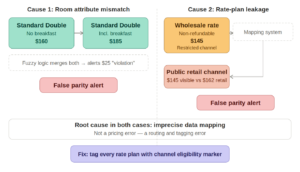
Consider a scenario where a property offers two variations of a “Standard Double” room. One variation includes a complimentary breakfast voucher, while the other does not. Suppliers load both into their feeds with slight name variations that fuzzy logic systems might merge. If the room without breakfast sells for $160 and the one with breakfast sells for $185, the rate shopping tool immediately flags a $25 parity violation. The revenue team spends valuable time investigating, only to find that the rates are perfectly correct for their respective products.
Another common operational headache is rate-plan leakage. A highly restricted, non-refundable wholesale rate of $145 might be inadvertently routed by a mapping system lacking rate-plan awareness into a public retail channel. When the shopping tool compares this to the standard retail rate of $162, an alert fires. No one on the pricing team authorized a $145 retail rate, because it is fundamentally a data routing error, not a pricing strategy shift.
Bridging the Divide: Empowering the Data Team
When rate parity is recognized as a symptom of imprecise mapping, the operational response can evolve from reactive frustration to structural resolution. Rather than routing every parity alert to the revenue team, organizations can implement a triage layer managed by the data team.
The primary triage question straightforwardly asks: Are the two rates being compared actually for the exact same room type, operating under identical rate-plan contexts, within the same distribution tier? If the answer is no, the system intercepts the alert as a mapping issue. This single procedural shift can reduce the alert volume burdening revenue teams by an astonishing 30 to 50 percent within the first month.
To achieve this, every rate plan entering the inventory management system must be tagged with a specific channel eligibility marker at the mapping layer. When the mapping system resolves a property ID, this channel context must travel with it. By adding this pre-alert validation step, organizations ensure that revenue teams only spend their time investigating genuine, actionable pricing anomalies.
The Pivot to Proactive Profit: Rebooking Economics
Once false parity alerts clear and the underlying mapping data becomes structurally sound, organizations position themselves perfectly to act on the second half of the equation: post-booking arbitrage.
A hotel essentially locks the price at the moment of a confirmed booking transaction. While the customer settles the financial commitment, yield management systems continuously adjust the market price of that room according to occupancy forecasts, deploy flash sales, and fluctuate wholesale allocations in the weeks leading up to check-in.
Unfortunately, many distribution platforms treat rebooking merely as a customer service function,a reactive goodwill gesture offered only when a guest complains about finding a cheaper rate online. This approach absorbs operational costs without generating strategic value.
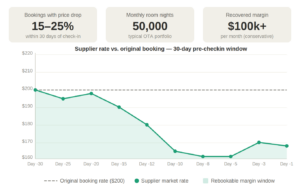
The proactive approach treats the post-booking window as an open arbitrage opportunity. Research indicates that across typical OTA portfolios, 15% to 25% of confirmed bookings will experience a price drop from at least one supplier within the 30 days prior to check-in. By continuously monitoring this window, organizations can seamlessly cancel the original booking and secure the exact same room at the newly lowered market rate. The platform captures the margin difference directly into its profitability while the customer experiences no change.
For a platform processing 50,000 room nights per month, capturing even a conservative rate of these opportunities can yield over $100,000 in recovered margin monthly—revenue quietly sitting in the data layer waiting for the platform to claim it.
Metasearch: Transforming a Cost Centre into a Margin Contributor
The strategic value of rebooking becomes incredibly pronounced when applied to high-cost acquisition channels like metasearch.
Metasearch platforms deliver high volumes of traffic, but they come with aggressive Cost Per Acquisition (CPA) structures that steadily erode net margins. A $20 CPA on a $200 booking consumes a massive portion of the gross margin before operational costs are even factored in.
However, metasearch possesses a unique characteristic that makes it highly compatible with rebooking strategies: metasearch users tend to book early. Because they are engaged in deep comparison shopping, these guests often confirm their reservations 14 to 60 days in advance of their stay. This extended lead time creates a wide, lucrative window for supplier rates to fluctuate and drop.
When an OTA implements continuous rate monitoring on a metasearch cohort, the economics of the channel shift dramatically. If a system can monitor 25,000 monthly metasearch bookings, identify the rebookable subset, and capture an average margin recovery of $32 per successful rebook, the platform can recover hundreds of thousands of dollars. This recovered margin effectively offsets the initial CPA drag, transforming a break-even channel into a highly profitable net contributor.
Architecting the Rebooking Engine: Stability and Idempotency
Transitioning from the concept of rebooking to automated execution requires careful architectural planning. Because rebooking interacts with live reservation systems, supplier connectivity, and customer records, the execution sequence must be bulletproof.
A sophisticated rebooking API typically interfaces with an OTA’s infrastructure at three critical points:
- The Booking Registry Hook: At the moment of confirmation, the system must capture the booking details. For most platforms, querying the reservation table asynchronously every 15 to 60 minutes is the safest and most reliable method to enroll bookings into the monitoring layer without creating real-time dependencies that could interrupt the primary checkout flow.
- The Rate Monitoring Layer: This system must continually poll alternative suppliers. To prevent overwhelming supplier APIs and triggering rate limits, this layer should utilize Time-To-Live (TTL) caching and employ smart fanout strategies, prioritizing the most reliable suppliers before querying secondary feeds.
- The Execution Layer: This is where architectural rigour is non-negotiable. The execution sequence must be strictly ordered and idempotent.
The most vital rule of the execution sequence is that a platform must never cancel the original booking until the alternative booking has returned a synchronous, confirmed success payload from the new supplier.
- Step 1: Validate that the cancellation policy of the original booking is still active.
- Step 2: Secure and confirm the new booking with the alternative supplier.
- Step 3: Only after Step 2 is successful, cancel the original booking.
If a system crashes mid-sequence, an idempotent architecture ensures that upon reboot, it can read the execution ID, determine exactly where it left off, and proceed without duplicating bookings or leaving a guest stranded.
Safeguarding the Guest Experience and Downstream Operations
A common hesitation among distribution leaders is the fear that proactive rebooking might disrupt the guest experience or alienate suppliers.
When executed correctly, proactive rebooking is entirely invisible to the consumer. The physical property, the room type, the dates, and the check-in experience remain identical. Furthermore, rebooking operates strictly on market rates that are openly available within legally permissible free-cancellation windows. It does not require special favours or backdoor agreements with suppliers; it simply utilizes standard commercial flexibility.
To ensure internal systems continue to run smoothly, it is imperative to utilize reservation identity abstraction. When a new supplier swaps a booking, the supplier naturally changes the confirmation code. If an OTA’s customer support dashboard, loyalty point accrual engine, or finance ledger relies on that supplier code as the primary identifier, rebooking will cause systemic confusion. By establishing an internal, immutable booking ID as the stable anchor across the tech stack, the supplier reference simply becomes a background variable that can change without disrupting downstream operations.
A Unified Distribution Strategy
Ultimately, the challenges of rate parity and the opportunities of rebooking are two sides of the same coin. They both rely on a foundation of pristine, standardized data mapping, and they both require a shift in perspective, from viewing the booking as a static event to viewing it as a dynamic lifecycle.
By cleaning up rate-plan mapping to silence false parity alerts, organizations free up their revenue teams to focus on true strategy. By deploying automated, idempotent rebooking architectures, they ensure that every drop in the market yield curve translates directly into their own P&L.
In a highly competitive landscape where fierce competition contests margins, platforms that stop chasing operational ghosts and start engineering proactive profitability achieve success.
If you are ready to modernize your distribution architecture, explore how Vervotech’s Profit Maximizer can help your platform safely automate post-booking arbitrage while utilizing advanced mapping capabilities to eliminate false parity alerts.
FAQs
Q: What causes false rate parity alerts in hotel distribution?
A: Many rate parity alerts are caused by inaccurate hotel or room mapping rather than actual pricing discrepancies. When non-equivalent room types or rate plans are compared across suppliers, pricing tools may incorrectly flag them as parity violations, leading to unnecessary investigations.
Q: How does hotel mapping improve rate parity monitoring?
A: Hotel mapping standardizes property and room data across multiple suppliers, ensuring that only truly equivalent hotels and room types are compared. This significantly reduces false parity alerts, improves pricing accuracy, and helps revenue teams focus on genuine pricing issues.
Q: What is post-booking arbitrage in travel distribution?
A: Post-booking arbitrage is the process of identifying lower supplier rates for an already confirmed booking before check-in and rebooking the reservation at a better net rate. The customer experience remains unchanged, while the travel business captures the difference as additional margin.
Q: How are rate parity and rebooking connected?
A: Both rely on accurate hotel and room mapping. Clean mapping ensures rate parity systems compare equivalent inventory and enables rebooking engines to confidently identify alternative supplier rates for the exact same hotel and room type without introducing booking errors.
Q: Does automated rebooking affect the guest experience?
A: No. When executed correctly, automated rebooking happens behind the scenes. The guest continues to stay at the same hotel, in the same room type, on the same dates. Only the supplier fulfilling the booking changes, allowing travel businesses to recover additional margin without impacting the traveller.
Q: Why is accurate hotel mapping important for OTA profitability?
A: Accurate hotel mapping reduces duplicate listings, minimizes false rate parity alerts, improves search relevance, and creates the reliable data foundation required for automated rebooking. Together, these improvements help OTAs reduce operational costs while increasing profitability.
Q: Can reducing false rate parity alerts improve operational efficiency?
A: Yes. By filtering out alerts caused by mapping errors, revenue teams spend less time investigating false positives and more time focusing on genuine pricing decisions. This improves productivity and enables faster, more strategic revenue management.
Q: How can OTAs recover margin after a booking has already been confirmed?
A: OTAs can recover margin by continuously monitoring supplier rates between booking confirmation and check-in. When a lower equivalent rate becomes available, an automated rebooking solution can switch suppliers while keeping the customer’s reservation unchanged, converting market price movements into incremental profit.