



When an OTA decides to implement a rebooking strategy, the first instinct is to monitor the original supplier. The logic seems safe: if Bedbank A drops their rate for the room we already booked, we cancel and rebook with Bedbank A. The integration is simple. The operational risk is low.
That logic is financially backward.
Same-supplier rebooking is not a margin strategy. It is an exercise in chasing pennies. A supplier’s yield management system rarely undercuts its own wholesale rates by a margin wide enough to justify the API load and execution risk. The true margin is found across the aisle. It is found in cross-supplier arbitrage. The more suppliers your system covers, the higher the probability that a lower rate for an equivalent room exists somewhere in your supply network at any given time.
Here is how the commercial model of cross-supplier arbitrage works, and why your architecture must be explicitly designed to support it.
The Yield Asymmetry Problem
The problem is not that Supplier A refuses to drop their rates. It is that Supplier A drops their rates uniformly based on their specific inventory constraints.
If you are only monitoring Supplier A, you are tied to a single yield curve. But bedbanks and wholesalers have different contracted rates, different promotional windows, and different inventory allocations. While Supplier A holds a $200 rate steady, Supplier B might load a flash sale to dump excess allocation for the exact same property, dropping the net rate to $160.
If your rate monitoring layer continuously polls 5 alternative suppliers for the same property and dates, you break the dependency on a single yield curve. The spread between Supplier A’s locked rate and Supplier B’s aggressive yield adjustment is where the real margin delta lives.
The Math of Cross-Supplier Arbitrage
The table below illustrates the compounding difference between a same-supplier monitoring configuration and a cross-supplier fanout strategy across a portfolio of 15,000 active bookings.
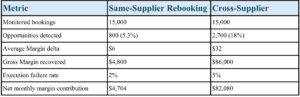
The math is not close. Restricting your monitoring layer to the original supplier severely limits both your detection volume and your average margin recovered per unit.
Also Read: Rebooking Economics: The Overlooked Margin Lever
The Architectural Prerequisite: Identity Abstraction
If the economic case for cross-supplier arbitrage is obvious, why do teams avoid it? Because cross-supplier rebooking breaks brittle software architectures.
When you rebook with a new supplier, you are changing the supplier ID and the supplier confirmation code in the reservation record. If your current architecture has downstream systems, like customer notification engines, finance platforms, or loyalty accrual systems, referencing the supplier_confirmation_code as a stable identifier, your rebooking operation will trigger a cascade of system errors.
The clean solution is reservation identity abstraction. Your internal booking_id remains stable through the rebooking process. The supplier ID and confirmation code must be treated as mutable fields on the reservation record. All downstream systems should reference your stable internal ID, ensuring that the customer sees no change to their confirmation details when you silently swap out the supplier backend.
The Room Equivalence Constraint
Cross-supplier rebooking introduces a secondary failure mode: mapping confidence.
If you rebook a “Deluxe Double” at Supplier A for a “Standard Twin” at Supplier B simply because the fuzzy text match looked close, you have not executed a successful rebook. You have executed a downgrade. That is not a rebooking win. That is a customer service problem scheduled for delivery.
Rebooking only generates clean margin recovery when the substitute room is genuinely equivalent to the original. You cannot query a raw supplier room code across alternative suppliers and expect a reliable match. The execution layer must query against a canonical room_type_id generated by a hardened room mapping layer. Without that foundation, the system cannot confidently identify that a room at Supplier B is genuinely equivalent to the room already booked at Supplier A.
Architecture is the margin. Vervotech’s Profit Maximizer is built precisely around this constraint. It executes rebooking logic on top of an AI-powered canonical mapping layer, which means the confidence threshold for cross-supplier equivalence is based on standardized attribute comparison, not fuzzy name matching.
Stop Chasing Pennies
The distribution transaction is not the last moment in the P&L. But if you restrict your margin recovery efforts to the supplier you already purchased from, you are treating an open marketplace like a closed loop.
True rebooking economics require an architectural foundation that supports cross-supplier identity changes and strict room-level mapping. When both are in place, your rebooking operation ceases to be a marginal discount program. It becomes a structural arbitrage engine.
FAQ
Q: Do suppliers penalize you for cancelling and rebooking with competitors?
A: No. Rebooking operates on market rates that are available within legally permissible, free-cancellation windows. The system finds a lower rate for an equivalent room that is genuinely available in open inventory. This is standard commercial practice and does not require pre-negotiated rebooking agreements.
Q: How many alternative suppliers should we query in the monitoring layer?
A: Querying every supplier in your network simultaneously generates a massive API load that can trigger rate limiting. A tiered approach works best: fanout across your top 5 suppliers by reliability, followed by sequential waterfall queries to others if no opportunity is found.
Q: Does cross-supplier rebooking change the check-in experience for the customer?
A: No. A properly executed rebook replaces the supplier booking behind the scenes without changing the customer’s check-in details, room type, or original confirmation number. The customer experience is identical.
Q: How do we handle different cancellation policies across suppliers?
A: An opportunity scoring function must enforce strict minimum thresholds before execution. A primary rule is that the alternative supplier’s policy must equal or exceed the flexibility of the original booking. If the original is fully flexible, the alternative must also be flagged as “free_cancellation” in the monitoring layer.
Explore how Vervotech’s Profit Maximizer handles cross-supplier execution architecture for engineering teams starting from an existing booking flow.