



When a rate parity alert fires, the instinct is to open the pricing console. Somewhere a rate is out of position, and someone on the revenue team needs to find it and fix it. The assumption is that a rate parity violation is a pricing event.
That assumption is wrong more often than most distribution teams realize.
A significant portion of what hotel rate shopping tools flag as parity violations are not pricing decisions at all. They are mapping errors. The wrong room type has been matched to the wrong rate plan, or the wrong property ID has been resolved to the right property name, or a rate plan designed for a specific channel has been mapped to a broader inventory pool. The price is not out of line. The map is.
This matters because pricing teams and data teams fix things differently. If you are routing a mapping problem to a pricing team, the fix will not hold.
What Rate Parity Monitoring Actually Sees
Rate shopping tools compare prices for what they believe is the same room at the same property across different distribution channels. The word “believe” is doing real work in that sentence.
The comparison depends on the tool’s ability to identify that Channel A’s “Superior Double, City View” and Channel B’s “Standard Room, Double Bed” are the same physical room. If the tool is matching on name similarity or broad property ID resolution, it will sometimes compare rooms that are not equivalent.
When a non-equivalent comparison produces a price difference, the tool flags a violation. The revenue team investigates. They check the rates. The rates are correct for the room type being sold. Nobody finds a violation because there is no pricing violation. There is a mapping error in the monitoring tool itself.
Three Scenarios Where Mapping Errors Create False Parity Alerts
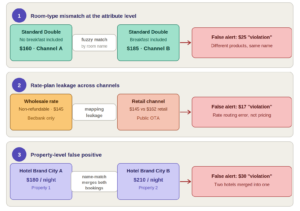
Scenario 1: Room-type mismatch at the attribute level
A hotel sells two room types that share the same base category: Standard Double. One includes a breakfast voucher. One does not. Both are loaded into different supplier feeds under category names that are close enough for a fuzzy matching system to treat as equivalent.
The rate for the room without breakfast is $160. For the room with breakfast is $185. Hence, the rate shopping tool flags a $25 parity violation. The revenue team investigates and finds no pricing error. The rates are correct. The tool compared two different products.
Scenario 2: Rate-plan leakage across channels
A non-refundable rate of $145 is loaded for a specific wholesale channel with contractual restrictions on redistribution. A mapping system without rate-plan awareness resolves the property ID and loads the wholesale rate into the retail inventory pool. The rate shopping tool sees the wholesale rate appearing in a retail channel at $145 against the standard retail non-refundable at $162.
The alert fires. The pricing team cannot explain the $17 difference because no one on the pricing team loaded a $145 rate to that channel. The source is a rate-plan mapping error that pulled the restricted wholesale rate into a retail context.
Scenario 3: Property-level false positive
Two adjacent properties in a city center, from the same hotel group, share a brand name with different suffixes. A mapping system running on name-matching logic treats them as the same property. Rates from both properties are pooled under a single property record.
The rate shopping tool sees a single property selling at two different price points simultaneously. The violation is real in the data but not real in the commercial sense. The property is not violating parity. The mapping system has merged two different hotels.
Also Read: Hotel Mapping API Pricing: What Nobody Tells You
Where Hotel Rate Shopping Tools Fail Without Clean Mapping
Rate shopping tools are only as reliable as the room and property mapping that underlies them. The tools themselves often do not own that mapping layer. They rely on the mapping supplied by the distribution platform or the OTA’s internal matching system.
If that mapping is off at the room level, the rate comparison is off at the room level. The tool reports faithfully on what it sees. What it sees is a function of what was mapped to what.
This is why teams that invest in rate shopping tools without simultaneously auditing their room-level mapping often spend significant analyst time chasing violations that are not there. The alert queue grows, the team grows to manage the queue, and the root problem stays fixed in the data layer.
The more productive frame: treat every unexplained rate parity alert as a hypothesis about a mapping error first, a pricing error second.
The Rate-Plan Mapping Layer That Most Systems Skip
Property mapping is now a solved problem for most mature distribution platforms. The harder layer is rate-plan mapping.
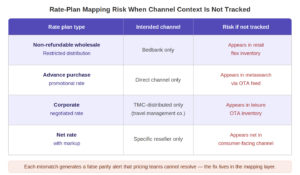
A single property may have 20 to 50 active rate plans at any given time: advance purchase, non-refundable, flexible, promotional, corporate, wholesale, channel-specific, and seasonal. Each rate plan has an intended channel of distribution and a contractual context that defines where it can appear.
When mapping systems resolve property IDs without tracking rate-plan context, restricted rates travel to unintended channels. The result looks like a pricing decision. It is a data routing error.
Rate-plan-aware mapping tracks not only which property and room type a rate belongs to, but which channel context the rate is valid for. When a restricted rate appears in an unintended context, the system flags it as a mapping routing error, not a pricing violation.
Also Read: The Margin Multiplier Stack: Mapping and Rebooking
How This Reframe Changes the Fix
If you accept that a significant share of parity alerts are mapping errors, the operational response changes.
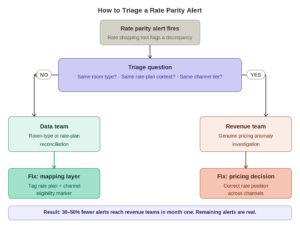
Instead of routing all alerts to the revenue team for rate investigation, you route a triage layer to the data team first. The triage question is simple: are the two rates being compared actually for the same room type, under the same rate plan context, in the same channel tier?
If the answer is no, the alert is a mapping issue. It goes to the data team for room-type or rate-plan reconciliation. If the answer is yes, it goes to the revenue team as a genuine pricing anomaly.
This single process change typically reduces the alert volume that reaches revenue teams by 30 to 50 percent in the first month of implementation. The alerts that remain are real. They get faster attention because the queue is shorter.
Vervotech’s Profit Maximizer includes rate-plan context tracking that flags when restricted rates appear outside their intended channel, which allows distribution teams to separate genuine pricing violations from data routing errors before the alert even reaches the revenue desk.
Building Mapping Audit Into Your Rate Parity Workflow
The practical implementation has three steps.
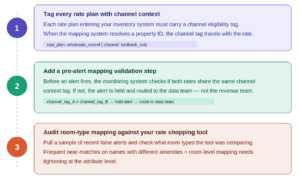
Step 1: Tag every rate plan with channel context at the mapping layer. Each rate plan that enters your inventory management system should carry a channel eligibility tag. When the mapping system resolves a property ID, the channel tag travels with the rate.
Step 2: Add a pre-alert mapping validation step to your parity monitoring. Before an alert is sent, the monitoring system checks whether the two rates being compared are tagged for the same channel context. If they are not, the alert is held and routed to the data team instead of the revenue team.
Step 3: Audit your room-type mapping against your rate shopping tool’s comparison logic. Pull a sample of recent false alerts and check what room types the tool was comparing. If you find frequent near-match comparisons on room names that refer to different amenity sets, your room-level mapping needs to be tightened.
None of these steps require new software. They require that your mapping system is operating at the rate-plan and room-type level, not just at the property level.
The Alert Queue Is Telling You Something About Your Data
Rate parity tools are useful. The problem is using them as a first-pass diagnostic for problems that live in the mapping layer. When you route mapping errors to a pricing team, you get pricing investigations that find nothing, followed by the same alert the following week.
The fix is not a pricing decision. It is a mapping decision. The sooner that reframe reaches the teams managing distribution data, the fewer cycles get spent on alerts that were never pricing violations to begin with.
Explore Vervotech’s Hotel Mapping to see how rate-plan-aware mapping reduces false parity alert volume
FAQ
Q: Why do rate shopping tools generate false parity alerts?
A: Most rate shopping tools compare prices based on property IDs and room name similarity. When room-type mapping is imprecise or rate-plan context is not tracked, the tool compares rooms or rates that are not genuinely equivalent. The price difference it reports is real, but the underlying comparison is not valid.
Q: What is a rate-plan mapping error?
A: A rate-plan mapping error occurs when a rate designed for a specific channel context, such as a wholesale non-refundable, is routed through a mapping layer that does not track channel eligibility. The rate appears in an unintended channel, creating a price discrepancy that looks like a parity violation.
Q: How common are mapping-related parity alerts versus genuine pricing violations?
A: This varies by distribution stack complexity. Teams with multiple active suppliers and room-level mapping gaps often find that 30 to 60 percent of parity alerts are mapping-related on first audit. The proportion falls as mapping quality improves.
Q: Can rate shopping tools detect mapping errors on their own?
A: Not reliably. Rate shopping tools are comparison engines, not mapping auditors. They report on price differences between what they observe. Whether the underlying comparison is valid depends on the mapping quality of the distribution system they are monitoring.
Q: What should I do with a backlog of unresolved parity alerts?
A: Run a triage pass with a data analyst: for each alert, confirm whether the two rates being compared are for the same room type and rate-plan context. Alerts that fail this check are mapping issues. Alerts that pass are candidates for genuine pricing investigation.
Q: Does fixing mapping errors eliminate rate parity violations?
A: Not entirely. Genuine pricing violations do occur. The goal is to separate the signal from the noise so your revenue team spends time on real violations. Cleaner mapping produces fewer false alerts and faster resolution of real ones.