



Type “what is hotel mapping” into Google and you will get a dozen vague answers. Here is the direct one: hotel mapping is the process of figuring out that “Hotel Alpha” on Hotelbeds, “Hotel Alpha Downtown” on Expedia, and “HTL ALPHA DWTN” on Booking.com are the same physical building. We do this for a living, so this guide covers the definition, the three technical approaches, and the questions you should ask before buying.
“Property matching gets you in the game. Room-level matching is how you actually win margin.”
What hotel mapping actually is
Hotel mapping is the process of matching hotel records from different suppliers to a single, correct property, then assigning that property one stable ID your system can use everywhere. Every supplier, whether a global distribution system, a bedbank, or a direct hotel contract, sends its own version of the same hotel. None of them agree on the name, the ID, or the address format.
Take a real example. A three-star property in Dubai’s Al Barsha district might arrive from three suppliers looking like this:
- Hotelbeds sends it as “Hotel Alpha” with property ID
HB-88213 - Expedia sends it as “Hotel Alpha Al Barsha” with property ID
EXP-4471029 - A direct contract sends it as “ALPHA HTL DXB” with no standard ID at all, just a spreadsheet row
These are the same 120 rooms, the same GPS coordinates, the same pool on the fourth floor. Without mapping, your OTA shows this hotel three times in search results, at three different prices, with three different photo sets. A guest could book the same room twice on your own site without realizing it. Mapping collapses all three records into one, so your platform, and your customer, only ever sees “Hotel Alpha” once, with every supplier’s rates sitting underneath that single entry. This is the core job of a hotel mapping API, turning scattered supplier feeds into one canonical catalog. For the broader picture of how mapping fits into a hotel distribution stack, see our guide on what hotel APIs are and how they power booking platforms.
Why hotel mapping exists
Hotel mapping exists because there is no universal hotel ID. No global registry exists that every supplier, GDS, and hotel chain agrees to use. Amadeus has its own property codes, Sabre has its own, and Hotelbeds, WebBeds, and TBO Holidays each run their own internal catalogs, built up over years of contracting the same hotels through different channels.
The result is what we call duplicate data at scale. If you connect to 15 suppliers, as most mid-sized OTAs eventually do, you are not managing 15 clean hotel lists. You are managing 15 overlapping, inconsistently formatted views of a smaller set of actual physical hotels, often the same 200,000 to 400,000 properties repeated with small variations. Our integrations hub tracks over 400 supplier connections, from WebBeds to TBO Holidays to GTA, and the overlap between any two of them in a major market like Dubai, Bangkok, or London routinely runs past 60%.
This creates three problems for anyone running a booking platform:
- Duplicate listings. The same hotel shows up multiple times in search results, confusing travelers and hurting conversion.
- Rate comparison failure. If you cannot confirm two records are the same hotel, you cannot tell a customer which supplier has the cheaper rate for the same room.
- Broken rebooking. When a supplier cancels a reservation, automated rebooking depends on instantly finding the same hotel and room at another supplier. Without accurate mapping, that lookup fails and a human has to intervene, usually under time pressure.
This is also why hotel mapping and hotel rebooking sit so close together operationally. Mapping is the lookup table that makes rebooking possible in the first place. We cover the margin math behind that relationship in our piece on what hotel mapping API pricing actually looks like, since a 1% improvement in mapping accuracy has a measurable, compounding effect on gross margin once rebooking automation is layered on top.
Three ways to do hotel mapping
There are three technical approaches to matching hotel and room records across suppliers. Each has a different cost profile, accuracy ceiling, and maintenance burden. Vendors rarely explain the trade-offs clearly, so here is the honest version.
1. Rules-based mapping
Rules-based mapping uses deterministic logic: exact or fuzzy string matching on hotel names, geocoding to compare latitude and longitude within a set radius, and address parsing to normalize street formats. If the GPS coordinates match within 50 meters and the name similarity score clears a threshold, the system calls it a match.
This works well on clean data and is fast to build. It breaks down on real-world supplier data, because GPS coordinates are frequently wrong by hundreds of meters, hotel names get abbreviated differently by every supplier, and new hotels with sparse metadata slip through the rules entirely. Most rules-based systems plateau around 90-95% accuracy in well-covered markets and considerably lower in emerging destinations with inconsistent address data.
2. Machine learning mapping
Machine learning mapping trains a model on labeled pairs, matched and unmatched hotel records, and lets the model learn which combinations of features (name similarity, distance, star rating, amenity overlap, review count) actually predict a true match. This catches patterns a human would never encode as a rule, like a supplier that consistently drops the district name from addresses in one country only.
The trade-off is that pure ML models need continuous retraining as new suppliers and hotels enter the catalog, and they can produce confident-looking wrong answers on edge cases the training data never saw. A model trained mostly on European hotel data will underperform on Southeast Asian guesthouses with sparse metadata unless it keeps getting fed fresh, labeled examples from those markets.
3. Hybrid mapping
Hybrid mapping runs deterministic rules first to handle the straightforward matches, routes ambiguous cases to a machine learning model, and sends the hardest remaining cases to human review. This is the approach we use, because it gets the speed and low cost of rules-based matching on the 80% of unambiguous cases, while catching the harder 20% with ML and human judgment instead of guessing.
The result is what lets us maintain
99.998% mapping accuracy across more than 3 million properties. A 4% mapping error rate, which is not unusual for pure rules-based systems on messy markets, translates to 40 wrong rooms per 1,000 bookings. At that error rate, a mid-sized OTA processing 50,000 bookings a month is issuing roughly 2,000 wrong-room confirmations every month. Hybrid mapping is built specifically to avoid that outcome.
Comparing the four mapping approaches
Here is how the four methods actually compare when you put them side by side, across the dimensions that matter to a buyer.
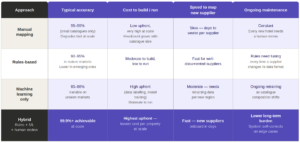
If you are evaluating vendors, ask which row they actually operate in, not which row their marketing page implies. Most “AI-powered” mapping vendors are running rules-based systems with a thin ML layer on top for the easy cases.
How mapping differs for OTAs, bedbanks, and metasearch
The mapping problem changes shape depending on where you sit in the distribution chain. This is the part most guides skip, and it is the part that actually determines what you should buy.
OTAs
An OTA typically connects to a handful of large suppliers, think Hotelbeds, WebBeds, TBO Holidays, and a growing set of direct contracts. The priority is deduplication for search results and price comparison. If the same hotel appears from two suppliers at different rates, mapping needs to surface the cheaper one without showing the property twice. OTAs also depend heavily on mapping for rebooking, since supplier cancellations need an instant, accurate fallback to another supplier carrying the same room.
Bedbanks
A bedbank sits on the supply side, aggregating inventory from hundreds of hotels and sub-suppliers, then reselling that inventory to OTAs and travel agents downstream. Bedbanks need mapping to consolidate their own upstream sources, other bedbanks, direct hotel contracts, regional wholesalers, into one clean catalog before they can sell it onward. Because a bedbank’s business model depends on reselling clean, de-duplicated content at scale, mapping errors here propagate to every OTA that resells the feed. This is why bedbank-facing mapping demands the highest accuracy threshold in the chain. Our bedbank API integrations hub covers how this typically gets structured.
Metasearch
Metasearch platforms compare prices across many OTAs for the same hotel, in real time, for a user actively shopping. Their mapping challenge is speed and breadth over depth. They need to correctly match a hotel across dozens of OTA listings within milliseconds, since users bounce immediately if a comparison page is slow. A missed match just means one fewer price shown, a lost opportunity but not a booking error. A false match, showing two different hotels as the same one, damages a metasearch brand’s credibility more than it damages an OTA’s.
- OTAs optimize mapping for accurate deduplication and rebooking continuity
- Bedbanks optimize mapping for upstream consolidation accuracy, since errors compound downstream
- Metasearch optimizes mapping for speed and breadth across many OTA sources simultaneously
A vendor that only understands one of these three use cases will underperform on the other two. Ask any vendor directly which of these three profiles their system was originally built for. If you are comparing vendors head to head, our roundup of the best hotel API providers breaks down how several of them handle this differently.
Room-level mapping matters more than most buyers realize
Most conversations about hotel mapping stop at the property level. That is a mistake, because property-level mapping alone does not fix the problem that actually costs money: room mapping.
Here is why. Once you have correctly matched “Hotel Alpha” across three suppliers, you still need to match the individual room types within that hotel. Supplier A calls a room “Deluxe King.” Supplier B calls the identical room “King Deluxe Room.” Supplier C calls it “DLX-K” with no readable description. If your system cannot confirm these are the same room, you cannot compare rates at the room level, and that is where most of the actual margin sits, not at the property level.
This matters most for two operational functions:
- Rate shopping. The same room type is frequently priced differently across suppliers. Without room mapping, you are comparing property-level averages, not the actual room a guest is about to book, and you lose margin on every booking where a cheaper equivalent room existed under a different label.
- Rebooking. When a supplier cancels, rebooking needs to find not just the same hotel elsewhere, but the same room category, the same bed configuration, and the same board basis (breakfast included or not). Property-level mapping alone cannot support this. Room-level mapping can.
We built a dedicated room mapping API for this reason. Treating room mapping as a checkbox feature inside a property mapping product tends to produce shallow matching that fails exactly where the margin impact is highest. If a vendor cannot describe their room-mapping methodology beyond “we use AI,” push further.
A buyer’s checklist for evaluating hotel mapping vendors
Before signing with any mapping vendor, run through these questions. We get asked most of these directly by prospects evaluating us against alternatives, and the answers separate real infrastructure from a thin wrapper.
- What is your measured mapping accuracy, and at what catalog size was it measured? Accuracy on 50,000 properties and accuracy on 3 million properties are different claims.
- Is your approach rules-based, ML-based, or hybrid, and what percentage of matches go through human review? Vendors should be specific here, not vague.
- How do you handle room-level mapping, not just property-level? Ask for a concrete example of how they match room types with different names and no shared ID.
- How often do you refresh mappings, and what happens when a supplier changes its property ID? ID drift is common and breaks static mapping tables silently.
- What is your API latency for a mapping lookup? Anything materially above 500ms per call will slow down real-time search and metasearch comparison.
- How many suppliers do you currently support, and can you show integrations relevant to my market? Check their supplier integrations hub against your own supplier list before assuming coverage.
- What does onboarding a new supplier into your mapping system actually take, in days? This tells you whether their pipeline is automated or manual behind the scenes.
- Do you provide a static hotel content feed alongside mapping, or just IDs? Mapping without normalized content, photos, amenities, descriptions, leaves half the work undone. Check what a static hotel data API should include.
- How do you handle low-metadata properties, like small guesthouses or new-build hotels? This is where rules-based systems fail most often.
- Can I see your error rate broken down by region? Global averages hide regional weak spots, so ask for the breakdown, not just the headline number.
- How does your mapping integrate with a channel manager or existing XML setup? Check compatibility against your current XML API integrations before assuming a plug-and-play fit.
If a sales conversation cannot answer at least seven of these ten questions with specifics rather than marketing language, treat that as a red flag, not a formality. Pricing structure matters here too. Our breakdown of hotel mapping API pricing covers the traffic fees and package tiers that vendors rarely mention upfront.
Key takeaways
- Hotel mapping is the process of matching the same physical hotel across different supplier feeds and assigning it one stable ID, so your platform never shows duplicate listings.
- It exists because there is no universal hotel ID industry-wide, and every supplier runs its own naming and identification system.
- There are three core techniques: rules-based (fast, cheaper, caps around 90-95% accuracy), machine learning (adaptive, needs retraining), and hybrid (combines both plus human review, the only approach that reliably clears 99.9%+ accuracy at scale).
- OTAs, bedbanks, and metasearch platforms each need mapping optimized for different priorities: deduplication and rebooking for OTAs, upstream consolidation for bedbanks, and speed plus breadth for metasearch.
- Room-level mapping matters as much as property-level mapping, and arguably more, since most rate comparison and rebooking margin depends on matching room types accurately, not just properties.
- Before buying, ask vendors for specific accuracy numbers by catalog size and region, their methodology, and their onboarding timeline for new suppliers, not general claims.
Related Vervotech resources
- Hotel Mapping API – how our mapping engine resolves supplier records into one canonical catalog
- Room Mapping API – room-level matching for rate comparison and rebooking
- Supplier Integrations Hub – all 400+ supplier connections we support
- Static Hotel Data API – normalized property content alongside mapping