


A hotel API is the connection that lets your platform search, price, and book hotel inventory without a human touching a spreadsheet. If you are choosing a hotel API stack in 2026, this guide covers the four API types, the top 15 providers by category, real pricing structures, integration timelines, and the build vs. buy math CTOs actually run before signing a contract.
“The cheapest hotel API is the one that gets you to production before your CFO asks why the roadmap slipped again.”
What a hotel API actually is
A hotel API is a set of endpoints that a supplier, aggregator, or GDS exposes so your booking engine can pull hotel data programmatically instead of manually. Every hotel API integration, no matter the vendor, does some combination of four jobs.
The four API categories
- Search / availability APIs – return which rooms are open for a date range, at what price, with what cancellation terms. This is the endpoint your users hit every time they search.
- Booking APIs – hold, confirm, modify, and cancel a reservation. This is where the money moves, so it carries the strictest SLAs.
- Content APIs – static data: names, addresses, photos, amenities, room descriptions, star ratings. This rarely changes and should be cached, not queried live. Our hotel content API reference breaks down what a complete content payload should include.
- Mapping APIs – match the same physical property across multiple suppliers so you don’t show “Taj Palace Hotel” and “The Taj Palace” as two separate listings. See our hotel mapping API guide for how this works underneath a multi-source hotel API stack.
Most teams underestimate category four until they plug in a second supplier and duplicate listings start showing up in search results. We covered this problem in detail in what is hotel mapping and room mapping, and in what are hotel APIs and how do they power online travel platforms.
Types of hotel API providers
Not all hotel API providers sell the same thing. Knowing which category you need narrows your shortlist fast.
GDS (Global Distribution Systems)
Amadeus, Sabre, and Travelport built their hotel APIs on top of airline reservation infrastructure from the 1990s. They are strong on major chain inventory and corporate rate access, weaker on independent and boutique properties. Sabre’s Content Services for Lodging returns fewer static fields per property than a purpose-built bedbank content feed, which is one reason most OTAs pair a GDS with at least one bedbank. See our Amadeus integration page, Sabre integration page, and Travelport integration page for connection specifics.
Bedbanks and wholesalers
Hotelbeds, WebBeds, TBO Holidays, RateHawk, and Restel buy hotel inventory in bulk at net rates and resell it to travel businesses through an API. This is the category most OTAs and metasearch platforms lean on for breadth outside major chains. Our bedbank API hub lists connection details across this group, alongside dedicated pages for Hotelbeds, WebBeds, and TBO Holidays.
DMCs (Destination Management Companies)
GTA, Restel, and JacTravel operate as regional specialists, often with contracted rates in specific destinations that larger bedbanks don’t carry. They matter most if your traffic concentrates in a handful of regions. Reference pages: GTA, Restel, JacTravel.
Channel managers
These sit on the supply side, syncing rates and availability from a hotel’s property management system out to multiple OTAs. They are not a demand-side hotel API in the way a bedbank is, but they matter if you are building for hotels rather than travelers. Our channel manager API hub covers this category.
Aggregators
An aggregator sits between you and dozens of suppliers, normalizing formats so you write one integration instead of fifteen. This is where mapping accuracy becomes the deciding factor, because an aggregator is only as good as its ability to tell you when two suppliers are describing the same room. Our hotel API aggregator hub and B2B hotel API hub cover this in more depth, and our 2025 hotel API providers comparison looks at ten of these vendors side by side if you want a second reference point alongside this guide.
Top 15 hotel API providers in 2026
This table sorts providers by type so you can shortlist by what you actually need: GDS coverage, bedbank breadth, regional depth, or aggregation.
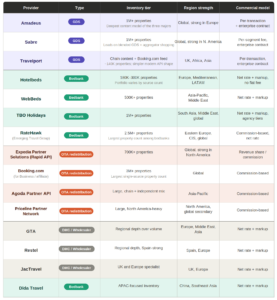
Inventory figures move fast in this industry and every vendor counts “properties” differently, some include activities and transfers in their headline number, some don’t. Treat every figure in this table as a starting point for your own diligence call, not a final number to build a business case on. For a live, supplier-by-supplier breakdown across 400+ integrations we track, see our supplier integrations hub, which stays current as vendors update their published numbers.
Pricing structures: how hotel APIs actually charge
Hotel API pricing rarely shows up on a public pricing page. Most vendors negotiate based on projected volume, so what you pay depends heavily on how much business you bring. Four models dominate.
- Per-transaction / per-booking fee. You pay a fixed amount or percentage each time a booking completes. Common with GDS connections and some bedbanks. This aligns cost with revenue but makes forecasting harder at low volume.
- Per-hit / per-API-call pricing. Amadeus’s Self-Service tier historically priced individual API calls between roughly $0.0008 and $0.024 depending on the endpoint, before the tier’s planned shutdown in mid-2026 pushed self-service users toward enterprise contracts or alternative suppliers. This model punishes chatty integrations that call the API on every keystroke instead of debouncing search requests.
- Revenue share / commission. The vendor takes a cut of each booking’s value instead of a flat fee. Expedia Partner Solutions and most OTA redistribution APIs (Agoda, Priceline, Booking.com affiliate feeds) run on this model. You pay nothing upfront but give up margin per booking indefinitely.
- Flat fee / subscription. Rare for hotel content and booking APIs, more common for mapping and content-layer tools priced by property count or API call volume rather than per booking. This is the model to look for if you want predictable monthly costs regardless of booking volume.
Mapping and content-layer pricing deserves its own line item because it is easy to overlook until you are three suppliers deep and duplicate listings start costing you conversions. We laid out real mapping pricing ranges, including what vendors don’t volunteer upfront, in Hotel Mapping API Pricing: What Nobody Tells You.
Integration timelines: what one hotel API integration actually takes
Ask any engineering lead who has done this twice and they’ll tell you the sandbox demo always looks faster than production reality.
Direct integration, one supplier
- Application and approval: 2-4 weeks. Not every applicant gets approved; high-volume projections get priority.
- Commercial negotiation: 2-6 weeks. Rates, commission tiers, and minimum volume commitments are individually negotiated, not published.
- Sandbox access and API review: 1-2 weeks to read documentation, endpoint specs, and error codes before writing code.
- Development and testing: 4-8 weeks to build search, price check, book, retrieve, and cancel flows, plus a content sync job and property ID mapping.
- Vendor technical review: 1-2 weeks for the supplier to certify your integration before granting production access.
Add it up and a single direct GDS or major bedbank integration runs 10-20 weeks end to end for a competent team, before you write a line of code for the second supplier. RateHawk’s sandbox-to-production path tends to run shorter, around 3-6 weeks, because its certification process is lighter than a GDS review.
Integration via an aggregator
An aggregator collapses that 10-20 week timeline into one integration that then covers dozens of suppliers, because the normalization, mapping, and format translation work is already done. The tradeoff is that you inherit the aggregator’s mapping accuracy as your own. A 4% mapping error rate sounds small until you realize it means roughly 40 wrong rooms shown per 1,000 bookings, a support and refund cost that compounds every month you run on it. Our XML API integrations catalog and supplier match tool are built specifically to shorten this evaluation step before you commit to a vendor.
Build vs. buy: the actual math
Most CTOs run this calculation once they have two or three supplier contracts signed and realize the integration work doesn’t stop after launch.
Building in-house
- Initial build: 3-6 months per supplier for a small team to reach production quality, longer if you need mapping and deduplication logic built from scratch rather than bought.
- Engineering cost: a custom multi-supplier integration layer commonly runs $50,000-$200,000+ in initial development, before ongoing maintenance.
- Maintenance burden: suppliers change schemas, deprecate API versions, and adjust rate rules on their own schedule. Budget ongoing engineering time every quarter just to keep existing connections working, on top of whatever new features you’re shipping.
- Mapping debt: once you add a second and third supplier, someone has to reconcile duplicate properties across sources. This is rarely budgeted in the original build estimate and becomes a permanent line item.
Buying (aggregator or mapping layer)
- Time to first integration: weeks, not months, since normalization and mapping logic already exist.
- Ongoing cost: usage-based or flat fee, but predictable, and it scales with your business rather than your headcount.
- What you give up: some control over exactly how mapping rules are tuned, and dependency on a vendor’s roadmap for new supplier connections.
Most mid-sized OTAs we work with spend 6-9 months building their first two or three supplier integrations in-house, then discover the real cost shows up in month 12 when a supplier changes its schema and nobody on the team remembers why the booking flow broke. That is the maintenance burden the initial build estimate never accounted for. We wrote a fuller breakdown of hotel API fundamentals in what are hotel APIs and how do they power online travel platforms, and the mapping-specific cost curve in hotel mapping API pricing: what nobody tells you.
What to ask any hotel API vendor in a demo
A vendor demo is built to show you the best case. These questions surface what happens outside it.
- What’s your actual mapping accuracy, measured how? Ask for the methodology, not just the headline number. “99.9% accurate” measured against a curated test set is different from accuracy across your live traffic mix.
- What happens when two suppliers disagree on room type? This is where duplicate listings and overbooking risk originate. Get a concrete example, not a general answer.
- What’s your average response time under load, not in a sandbox demo? Rate parity checks that take 4-6 seconds per property on a GDS during a live demo can behave very differently at your peak search volume.
- How do you handle schema changes and version deprecation? Ask how much notice you get and whether backward compatibility is guaranteed for a fixed window.
- What does content refresh frequency actually look like? Static content that updates weekly is fine for descriptions, not fine for amenity changes that affect a live booking decision.
- Can I see a real client’s mapping dashboard, not a demo account? If a vendor won’t show live production data under NDA, that itself is a signal.
- What’s the true cost at my volume, not the rate card? Get the vendor to price out your actual projected booking volume in writing, not a generic tier.
Key takeaways
- A hotel API integration covers four distinct jobs: search, booking, content, and mapping. Most vendors are strong in one or two, not all four.
- GDS providers (Amadeus, Sabre, Travelport) cover chain hotels well but thinly on independents; bedbanks (Hotelbeds, WebBeds, TBO Holidays, RateHawk) fill that gap at net rates.
- Pricing runs on four models: per-transaction, per-hit, revenue share, and flat fee. Get your actual projected volume priced in writing before you sign, since published rate cards rarely reflect what you’ll pay.
- A single direct supplier integration realistically takes 10-20 weeks. An aggregator collapses that timeline but makes the aggregator’s mapping accuracy your problem too.
- Building in-house costs $50,000-$200,000+ upfront plus a permanent quarterly maintenance line item most teams don’t budget for at the start.
- Before signing with any vendor, ask for mapping methodology, load-tested response times, and a real production dashboard, not a sandbox demo.